

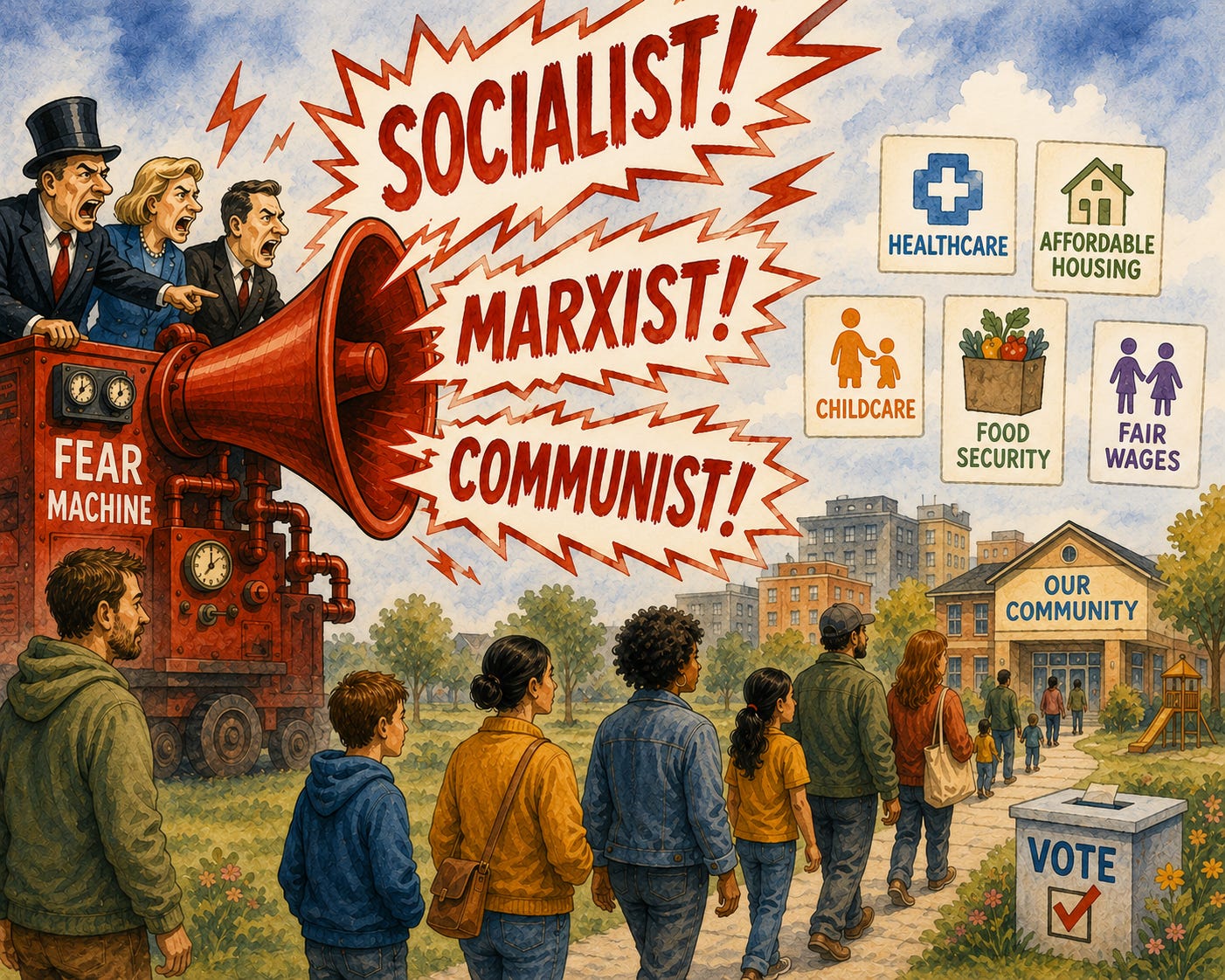
Last November, Zohran Mamdani won the election to become New York City’s next mayor. The fearmongering was immediate. New York City had elected a Democratic Socialist. Societal collapse was imminent.
Since then, not only has nothing catastrophic happened to the city, but Mamdani has been delivering on his campaign promises, with roughly three-quarters of New York City residents polled saying he is a hard worker.
Mamdani used his success and name recognition to support three Democratic Socialists running for Congress. All three won their primaries. The spin machine went into high gear. “Socialists! Marxists! Communists!” The last one may be the most incorrectly used term in American politics.
Half the time, “communist” is used for someone who supports healthcare that doesn’t bankrupt you. Franklin Roosevelt, Harry Truman, and Martin Luther King Jr. were all called communists by their opponents. None were, and none of the winners of New York’s democratic primaries are either.
The fear wasn’t just from Republicans. Some moderate and centrist Democrats also raised the alarm. Fifteen Democrats — 10 members of Congress and 5 candidates — signed onto a Promise to America pledge to stand against extremism, including both fascism and socialism.
What didn’t we hear among all of this panic? Any debate about the actual proposals of the candidates. That is because many of the positions are not extreme at all. They are mainstream in other wealthy capitalist democracies.
The midterms are not an election about whether America should abandon capitalism and become a socialist nation. It is about the struggles millions of hard-working Americans face every day as prices continue to rise, wages fall further behind, healthcare costs keep rising, housing costs are out of control, and Congress does nothing about it.
People are fed up with the establishment.
That is the part that too many politicians still do not understand. Voters are not sitting around reading Oscar Wilde or Upton Sinclair and debating the merits of socialism. They are looking at rent, groceries, gas, medical bills, childcare, and wages that can’t keep up with it all. They are asking why the wealthiest country on earth keeps telling them to work harder and retire later while the rich continue to collect an ever-increasing share of wealth.
In American politics, the word “socialist” is used as a scare word for anything that reduces corporate power or expands public benefits. But most of the policies being discussed are not about state ownership of the economy. They are normal social-democratic policies.
Ensuring that every resident has healthcare and that receiving medical care does not cause financial hardship.
Pushing for better wages that support a decent standard of living.
Providing early childhood education, such as universal Pre-K, and affordable childcare.
Restoring food assistance benefits that were cut. Current accounting, based on only a partial list of states, shows that roughly 700,000 children have already lost SNAP benefits, with estimates suggesting the total could reach 1 million or more.
Worker rights, including collective bargaining, paid sick days, paid parental leave, and paid vacation days.
Tenant rights, such as eliminating junk fees, holding landlords accountable for repairs, and implementing rent control during a time of unaffordable housing.
These are the positions we are supposed to be terrified of. That is not communism. It is also not socialism. It is a government working to ensure people can live decent lives. These are policies used in other major capitalist democracies and are often described as “the rich are still rich, but no one is poor.”
There is strong support for these policies in the US, too, which makes them so hard to debate. And that is where the fearmongering comes in.
Instead of arguing why private insurance companies should be allowed to charge outrageous amounts of money while denying legitimate claims, it is easier to point and shout “socialist!”
Instead of arguing why full-time workers should not earn enough to live, it is easier to call a living wage radical.
Instead of arguing why the richest country in the world cannot feed children, provide affordable childcare, or guarantee paid leave, it is easier to pretend every public benefit is a slippery slope to the Soviet Union.
But the word “socialist” does not scare people the way it used to. That is why the panic so quickly escalates to “communist,” as if we are back in the McCarthy era and every demand for a better life is a plot to overthrow the country.
The real problem for the establishment is that this name-calling has stopped working.
The Democratic Party currently has a lower approval rating than the Republican Party, even though Republicans are in power as everything worsens. Many voters do not see congressional Democrats fighting hard enough against Trump and MAGA, and they do not see a concrete enough plan to move the nation forward. The main message has been “Elect us because Trump is bad.” Trump is bad, but people also want solutions.
Democrats in Congress as a whole have a 20% approval rating. Among Democratic voters, their approval is only 41%, according to Quinnipiac polling.
Mamdani has a 48% approval rating among all New York City adults and a 63% approval rating among New York City Democrats, according to Marist polling. Those numbers explain why the establishment is nervous.
There are other Democrats and Democratic-aligned politicians with polling numbers similar to, or even better than, Mamdani’s: Bernie Sanders, Elizabeth Warren, and Alexandria Ocasio-Cortez. AOC was previously endorsed by the DSA, but the national organization withdrew its endorsement in 2024 over disagreements related to Israel and Palestine. Bernie Sanders is not a DSA member, but he is a self-proclaimed Democratic Socialist. Elizabeth Warren is a progressive Democrat. The labels are not what drives their popularity. The issues and the fight do.
These are politicians associated with concrete economic battles: taxing the rich, lowering healthcare costs, protecting workers, taking on corporate power, reducing student debt, defending Social Security and Medicare, and making government work for normal people instead of billionaires.
That is what voters are responding to.
They are not asking for America to abandon capitalism. They are asking why capitalism in America has become so brutal for working people while billionaires and corporations keep getting more power, more tax breaks, and more loopholes, with endless excuses created to defend it.
Democrats will win the House majority in November. There is also a chance they could take the Senate. When they do, America will still have freedom, democracy, and capitalism. The only real change will be that hardworking Americans will struggle less and have greater opportunities. Which is exactly what the majority of Americans want.
It is not capitalism versus socialism. It is whether the government will finally do something about the problems people live with every day. And that should not be scary at all.
The Economy Then And Now

Consumer sentiment has reached a record low for the second month in a row. Lower than during the pandemic and the 2008 financial crisis. Unlike during those times, there is no single large event to point to as the cause of the negativity.