

The federal minimum wage is a poverty wage in every state in the nation, and half of all full-time workers do not earn a livable wage. There is a simple solution to this problem. Raise the federal minimum wage to a livable wage. But whenever this is discussed, there is always an army of propagandists comprised of corporate lobbyists, industry groups, politicians, and the people who have fallen for their lies, who pop up and say that raising the minimum wage will drastically increase prices and cost jobs, so we will only end up worse than before.
Here’s the truth: raising the minimum wage does not cause meaningful job loss and has a negligible effect on prices. This has been proven time and again. Instead, it reduces poverty and hardship, improves health, reduces reliance on assistance programs, increases federal revenue, raises wages for workers already earning above the minimum wage, and bolsters the economy.
The question is not whether America can afford higher wages. It is why highly profitable companies are allowed to pay poverty wages, causing their workers to be subsidized by taxpayers.
The claim
If the government raises the minimum wage, businesses will have to fire workers, cut hours, replace people with machines, or raise prices so much that workers lose whatever they gained.
This is the argument used every time people ask for better wages. It sounds like it could be common sense until you look below the surface.
Why higher wages do not automatically mean job losses or huge price increases
I’m going to dive into all the data showing what really happens when the minimum wage is raised in a moment, but first I want to explain why raising the minimum wage does not affect prices and jobs the way you might expect.
The argument against raising the minimum wage usually treats businesses like a simple math problem: if wages go up, the business must either fire workers or raise prices by the same amount.
That sounds logical until you remember that labor is only one part of a business’s costs.
If a worker’s wage rises by 20%, that does not mean the price of a burger, pizza, hotel room, or grocery item needs to rise by 20%. The wage increase only affects the labor portion of the cost, and even then, only the workers whose wages are actually increased.
A restaurant, store, hotel, or warehouse also pays rent, utilities, insurance, equipment costs, debt payments, franchise fees, advertising, technology costs, ingredients, supplies, shipping, executive pay, corporate overhead, and profits to owners or shareholders. That is why a significant increase in the minimum wage does not translate into an equally large increase in prices.
Instead, price effects are usually small. San Jose raised its minimum wage by 25%, and restaurant prices rose by about 1.45%. California raised fast-food wages to $20 an hour, and Berkeley researchers found prices rose by about 1.5%, or roughly 6 cents on a $4 item. The wage increase was large. The price increase was not.
Here is what the CEO of McDonald’s said during a 2020 earnings call:
“Our view is the minimum wage is most likely going to be increasing, whether that’s federally or at the state level as I referenced, and so long as it’s done … in a staged way and in a way that is equitable for everybody, McDonald’s will do just fine through that.”
And here is what Denny’s CFO said about California minimum wage increases to investors:
“As they’ve increased their minimum wage kind of in a tempered pace over that time frame, if you look at that time frame from us, California has outperformed the system. Over that time frame, they had six consecutive years of positive guest traffic—not just positive sales, but positive guest traffic—as the minimum wage was going up.”
Quite a different tone and view than what we often hear from the restaurant industry in public about minimum wage increases. They say it will hurt business, hurt workers, and negatively impact the economy, but when it comes to their own business, they admit minimum wage increases won’t hurt them and may even improve their operations.
Sources for this section
National Restaurant Association, “Elevated labor costs had a significant impact on restaurant profitability in 2024.” Reports that salaries and wages, including benefits, represented a median of 31.7% of sales among limited-service restaurant operators in 2024.
Allegretto and Reich, “Are Local Minimum Wages Absorbed by Price Increases?” Finds that San Jose’s 25% minimum-wage increase raised restaurant prices by about 1.45%, and explains that restaurants can absorb labor-cost increases with relatively small price increases because labor is only one part of total costs.
Berkeley IRLE, “Effects of a $20 Minimum Wage.” Finds that California’s $20 fast-food minimum wage increased wages without reducing employment and increased prices by about 1.5%.
Dube, Lester, and Reich, “Minimum Wage Shocks, Employment Flows, and Labor Market Frictions.” Finds that minimum-wage increases reduced worker separations and new hires among affected workers without reducing overall employment levels.
Newsweek article discussing what companies are telling investors about minimum wages versus what they say publicly.
California’s $20 fast-food minimum wage
The most recent major study of this issue examined California’s increase in the fast-food minimum wage to $20 an hour. That increase went into effect on April 1, 2024, and covered workers at large fast-food chains.
This is a particularly important study because a $20 wage is a livable wage in many parts of the country, and the fast-food industry is exactly the kind of low-wage industry where opponents always predict disaster.
The disaster did not happen.
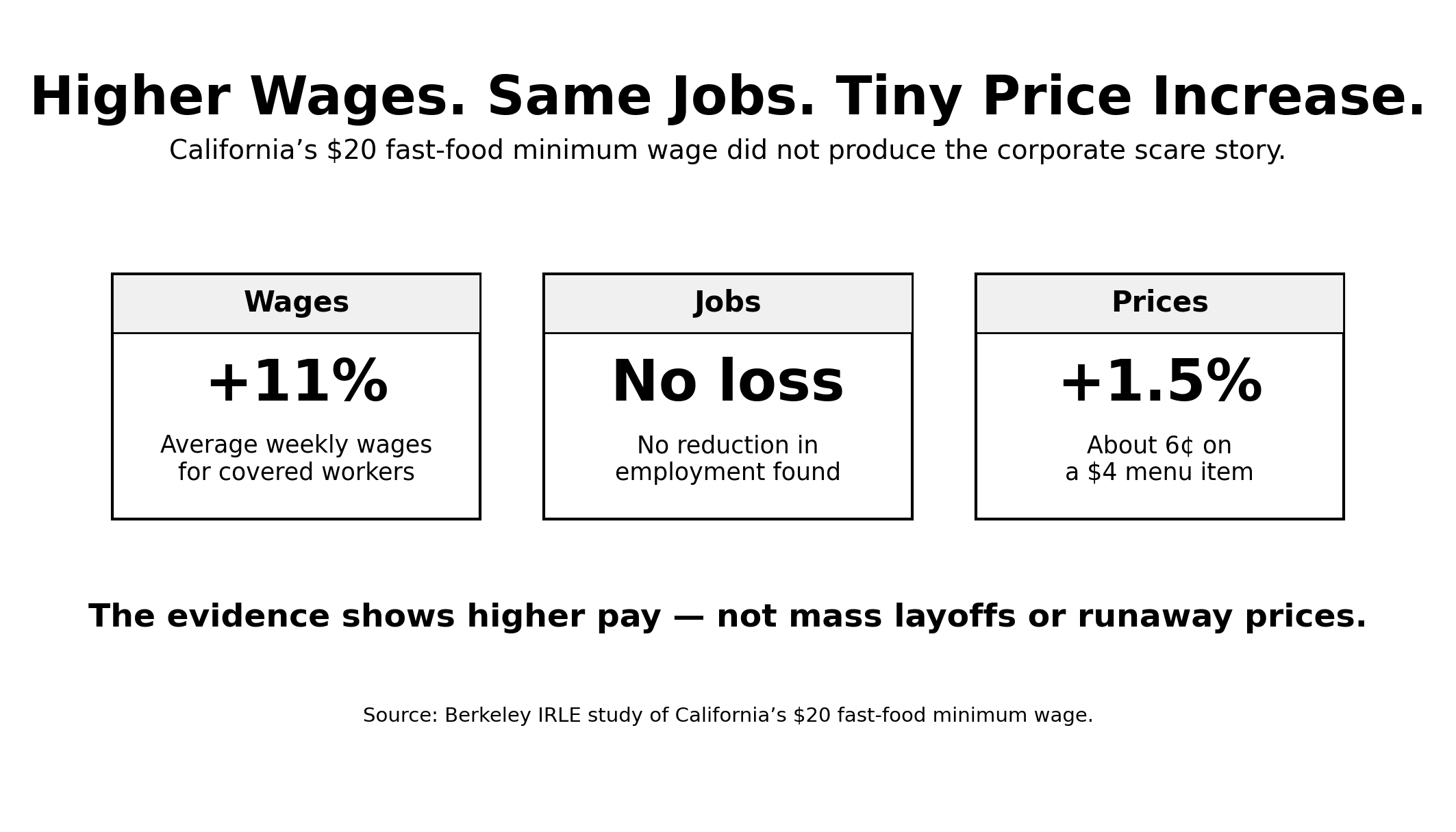
A Berkeley Institute for Research on Labor and Employment study found that California’s $20 fast-food minimum wage increased average weekly wages for covered workers by about 11%. It did not reduce employment. It did not reduce weekly hours. Prices increased by about 1.5%, which equates to a 6-cent increase on a $4 item.
Workers got a meaningful raise. Jobs did not disappear. Hours were not cut. Prices went up only a little.
A separate study from The Shift Project at Harvard Kennedy School surveyed fast-food workers during this wage change and also found no evidence of reduced work hours, increased understaffing, worse scheduling instability, increased wage theft, or reduced fringe benefits.
This is important because companies often claim they will be forced to respond to higher wages by cutting hours, worsening schedules, reducing benefits, or forcing fewer workers to do the same amount of work. The Shift Project did not find evidence of that happening after California’s fast-food wage increase.
Sources for this section
Berkeley IRLE, “Effects of a $20 Minimum Wage: Evidence from Granular Data on Wages, Employment and Prices.” This is the main California fast-food study finding an 11% increase in average weekly wages, no employment reduction, no implied reduction in weekly hours, and a 1.5% price increase.
The Shift Project, “Early Effects of California’s $20 Fast Food Minimum Wage.” This worker survey found no evidence of reduced hours, increased understaffing, worse scheduling instability, wage theft, or reduced fringe benefits.
Other minimum-wage increases show the same pattern
California’s fast-food increase is not the only example. The broader research points in the same direction: higher minimum wages raise pay, while the predicted mass job loss does not appear.
One of the most famous studies looked at New Jersey’s 1992 minimum wage increase. New Jersey raised its minimum wage from $4.25 to $5.05 an hour, while neighboring Pennsylvania did not. David Card and Alan Krueger surveyed fast-food restaurants in New Jersey and eastern Pennsylvania before and after the increase. They found no evidence that the higher minimum wage reduced employment in New Jersey fast-food restaurants compared with Pennsylvania.
This study became famous because it challenged the old textbook assumption that raising wages automatically means fewer jobs. It showed that real labor markets are not as simple as the corporate talking point.
A later study by Dube, Lester, and Reich compared counties on opposite sides of state borders from 1990 to 2006. That design allowed researchers to compare neighboring local economies where one side had a higher minimum wage and the other did not. They found no adverse employment effects in restaurants and other low-wage sectors.
Another major study by Cengiz, Dube, Lindner, and Zipperer looked at 138 state-level minimum wage increases from 1979 to 2016. Their finding is one of the easiest to understand: jobs paying below the new minimum wage largely disappeared because they became better-paying jobs, not because the jobs vanished.
Price studies tell a similar story. When San Jose raised its minimum wage by 25% in 2013, restaurant prices rose by about 1.45% on average. That is almost the same price effect found in the California fast-food study, where prices rose by about 1.5%.
This is what the evidence keeps showing: wages rise a lot more than prices. Workers gain real income. Businesses adjust through a mix of small price increases, lower turnover, productivity changes, reduced margins, and other adjustments.
The evidence does not support the idea that higher minimum wages cause mass job loss or huge price increases.
Sources for this section
Card and Krueger, “Minimum Wages and Employment: A Case Study of the Fast-Food Industry in New Jersey and Pennsylvania.” Classic fast-food natural experiment finding no evidence that New Jersey’s minimum wage increase reduced employment compared with Pennsylvania.
Dube, Lester, and Reich, “Minimum Wage Effects Across State Borders.” Contiguous-county study comparing counties across state borders from 1990 to 2006 and finding no adverse employment effects in restaurants and other low-wage sectors.
Cengiz, Dube, Lindner, and Zipperer, “The Effect of Minimum Wages on Low-Wage Jobs.” Study of 138 state minimum-wage increases from 1979 to 2016 finding that low-wage jobs shifted up in pay rather than disappearing.
Allegretto and Reich, “Are Local Minimum Wages Absorbed by Price Increases?” San Jose restaurant-menu study finding that a 25% minimum-wage increase raised restaurant prices by about 1.45%.
Berkeley IRLE six-city study. Examined higher local minimum wages in Chicago, D.C., Oakland, San Francisco, San Jose, and Seattle and found higher earnings without significant employment losses.
Higher minimum wages benefit workers — and everyone else
The most obvious benefit of raising the minimum wage is that low-wage workers get paid more. That alone is enough reason to do it.
Higher wages mean people can buy more food, pay rent more easily, cover utility bills, repair a car, go to the doctor, avoid debt, and live with less constant stress. Recent research has linked more generous minimum-wage policies to lower food insecurity among households with children, and broader research connects higher minimum wages with improved health and standard of living.
A person working full-time should not need to live in survival mode.
But higher minimum wages do not only help the workers who were making less than the new minimum. They also help workers who were already making a little more.
Economists call this the ripple effect, or spillover effect. When the wage floor rises, employers often raise wages above the new minimum too. They do this to preserve wage ladders, retain workers, compete with other employers, and avoid situations in which experienced workers leave for easier or less stressful jobs paying nearly the same amount.
That means higher minimum wages can benefit far more people than the workers who were literally making the old minimum wage.
Multiple studies and policy estimates show this effect reaching well beyond the minimum-wage worker. Some research finds wage spillovers extending up to around the 30th percentile of the wage distribution. In 2019, the Congressional Budget Office estimated that a $15 federal minimum wage by 2025 would directly raise wages for 17 million workers and could also raise wages for another 10.3 million workers earning above the new minimum. The Economic Policy Institute estimated that a $17 federal minimum wage by 2030 would affect about 22.2 million workers, or 15% of the U.S. wage-earning workforce, even after accounting for state and local minimum wages already higher than the federal floor.
The exact number depends on the size of the increase, the timing, and the wage distribution. But the pattern is clear: raising the minimum wage pushes wages upward for a large group of workers, not just the people at the very bottom.
Higher minimum wages also reduce the amount of low-wage work that taxpayers are forced to subsidize.
When companies pay workers too little to live on, those workers often need SNAP, Medicaid, housing assistance, the Earned Income Tax Credit, or other public supports to survive. Those programs are necessary because people need to eat, get healthcare, and keep a roof over their heads. But when profitable companies pay wages so low that workers still need public assistance, taxpayers are effectively helping subsidize the low-wage business model. Raising wages shifts more of that responsibility back where it belongs: onto employers who benefit from the labor.
Research from the Economic Policy Institute found that among workers in the bottom three wage deciles, every $1 increase in hourly wages reduced the likelihood of receiving means-tested public assistance by 3.1 percentage points. Another analysis from the Center for American Progress estimated that raising the minimum wage to $10.10 would reduce federal nutrition assistance spending by $46 billion over 10 years.
Reduced reliance on assistance programs means the government spends less. Increasing wages also means more people will pay federal income tax, which increases the government’s revenue. Paying workers more improves the government’s financial situation, which is critical at a time of rising deficits and dangerous levels of debt. On top of all that, higher wages increase spending, which in turn improves production. 70% of the US economy relies on consumer spending.
That is why this debate should not be framed as if higher wages only help “someone else.” They improve prosperity for the entire nation.
Sources for this section
CBO, “The Effects on Employment and Family Income of Increasing the Federal Minimum Wage.” Estimated that a $15 minimum wage by 2025 would raise wages for 17 million directly affected workers and many of 10.3 million potentially affected workers earning slightly above the new minimum.
EPI, “The impact of the Raise the Wage Act of 2025.” Estimated that a $17 federal minimum wage by 2030 would affect 22.2 million workers, about 15% of the U.S. wage-earning workforce, and provide $70 billion in additional annual wages.
Redmond, Doorley, and McGuinness, “The Impact of a Minimum Wage Change on the Distribution of Wages and Household Income.” Found wage spillover effects extending to the 30th percentile of the wage distribution.
Hamilton Project / Brookings, “The Ripple Effect of a Minimum Wage Increase on American Workers.” Explains how minimum-wage increases affect workers earning slightly above the minimum.
EPI, “Balancing paychecks and public assistance.” Found that among workers in the bottom three wage deciles, each $1 increase in hourly wages reduced the likelihood of receiving means-tested public assistance by 3.1 percentage points.
Center for American Progress, “The Effects of Minimum Wages on SNAP Enrollments and Expenditures.” Estimated that raising the minimum wage to $10.10 would reduce federal nutrition assistance spending by $46 billion over 10 years.
JAMA Network Open / PMC, “State Minimum Wage and Food Insecurity Among US Households With Children.” Found that more generous state minimum-wage policies may reduce food insecurity among households with children at risk of economic hardship.
We have done this before
America has already had a stronger minimum wage.
The federal minimum wage reached its peak in 1968. The country did not collapse. Businesses still existed. People still became rich. The economy grew at a faster pace than it does today. The national debt was much lower. The middle class was at its strongest.
That does not mean the 1968 minimum wage caused all of that on its own. The strong middle class came from multiple policies and conditions: stronger unions, higher taxes on the rich, more public investment, less extreme corporate power, and a political system that had not yet surrendered so much power to billionaires and corporate lobbyists.
The livable minimum wage was part of that system. A strong wage floor helped set a standard for the value of work.
Since then, Congress has allowed inflation to erode the federal minimum wage. The wage has been stuck at $7.25 since 2009. It has half the buying power today that it had in 1968, despite workers being more productive, the economy being much larger, and corporations earning record profits.
America was prosperous with a quality minimum wage in 1968, and it can be again today.
Sources for this section
U.S. Department of Labor, “History of Changes to the Minimum Wage Law.” Official history showing the federal minimum wage rose to $7.25 on July 24, 2009 and has not increased since.
EPI, “Setting high standards for a federal minimum wage.” Reports that the federal minimum wage reached $1.60 in 1968, equivalent to $12.62 in 2026 dollars, and was about 61% of the national median wage.
EPI, “The federal minimum wage is officially a poverty wage in 2025.” Discusses the collapse in the real value of the federal minimum wage and the workers left behind in states still using the federal floor.
The rebuttal
The minimum-wage debate is framed as either we have low prices and more jobs, or higher pay, higher prices, and fewer jobs. That framing benefits employers who want to exploit labor for profits.
The evidence shows the truth.
California raised fast-food wages to $20 an hour. Wages went up, employment did not fall, hours were not cut, and prices rose about 1.5%. San Jose raised its minimum wage by 25%, and restaurant prices rose about 1.45%. Broader studies across states, cities, and border counties repeatedly find little to no meaningful job loss from minimum-wage increases.
Higher minimum wages also ripple upward to workers who already earn above the minimum. They reduce hardship. They can reduce food insecurity. They can reduce reliance on public assistance. They put money in the pockets of people who will spend it in their communities.
If a business can only survive by paying poverty wages, then the problem is the business model. No one who works full time should be poor. America is rich enough to pay people a living wage. The only thing missing is the political will to make employers do it.
Receipts: The Rich Do Not Pay Their Fair Share

Receipts are longer documents that provide concrete information to correct misinformation. These can be bookmarked for easy access to information and to provide accurate talking points, along with graphs, data, and links.