

We’ve been told that taxation is theft, and any money spent helping someone else is an affront to capitalism. Those are lies.
Poverty is expensive. A low minimum wage is expensive. Lack of healthcare is expensive. Not just for the individuals dealing with those problems, but for the nation as a whole. The reality is that helping others costs far less than letting the problems continue.
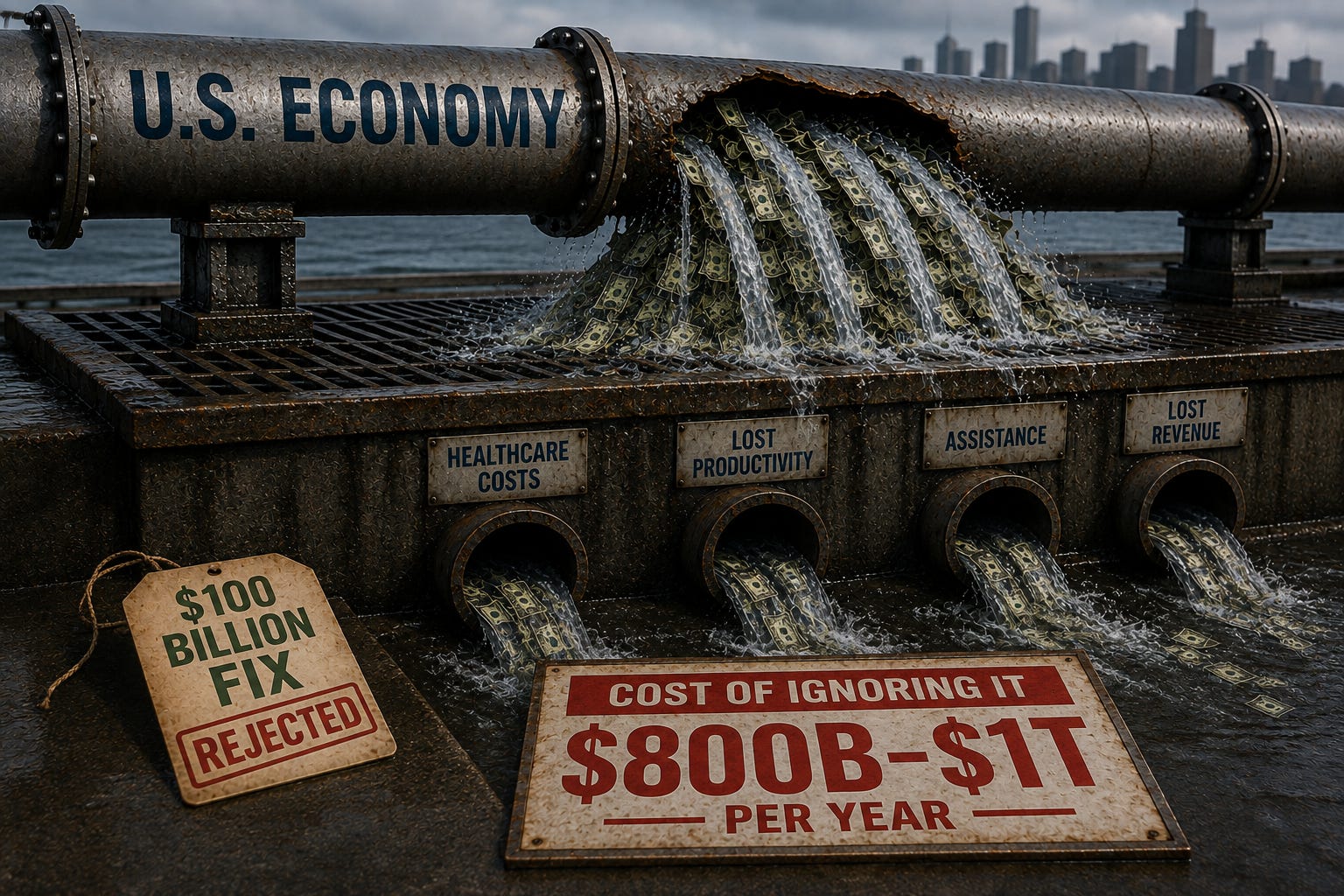
The poverty gap in the US, the difference between the resources of people in poverty and the poverty line, is roughly $250 billion. The National Academies found that childhood poverty alone costs the US around $800 billion to $1 trillion every year. That’s significantly more than it would cost to address it properly, and far too expensive when the country runs a $1.8 trillion deficit and has $40 trillion in debt.
We can implement and adjust programs that would cut the child poverty rate in half for around $90-$110 billion per year. A $100 billion investment to combat a $400-$500 billion expense seems like a no-brainer, but not only do we choose not to make that investment, in recent years we’ve done the exact opposite. We’ve made cuts that amount to tiny fractions of the budget, which did little to address our deficit, but were detrimental to the fight against poverty and will cost us far more than they saved.
Refusing to properly address the fundamental issues facing the nation is bleeding us dry.
Let’s start with the most direct cost. We have the basic morality in America to not want anyone to starve to death, families to have to sleep in the streets, or someone to bleed out and die because they lack adequate insurance. So we spend money to prevent that. But we spend far more than we need to because we want to tightly control how people receive assistance and how they spend it.
Instead of looking at someone who is hungry and can’t afford food and saying “Here is some money to help,” we created dozens of programs, each with different eligibility, targeted groups, and assistance amounts. Then, we give out cards that can only be used at specific locations for specified items. We bloat the solution with bureaucratic overhead, increasing complexity and cost, to deliver benefits that average just $6 a day per person.
America spends over $400 billion and loses billions more in revenue to manage poverty. That doesn’t include means-tested healthcare costs, which raises the total to over $1 trillion. We’re spending so much, yet over 40 million Americans continue to live in poverty.
That isn’t to say we could hand every person living in poverty their share of the gap and solve the problem for just $250 billion. The program would have administrative costs. People enter and leave poverty throughout the year, adding complexity. And putting someone $1 above the poverty threshold doesn’t mean their problems have vanished. But what it does show is that solving poverty is far more achievable than we think. In fact, the most successful programs that reduce poverty do exactly that: give people money.
Social Security doesn’t add one cent to the national debt and reduces the poverty rate of Americans 65 and older from 37% to 10%. It is massively successful, efficient, and simple.
Another example is the Earned Income Tax Credit (EITC). People who earn too little receive a tax credit to increase their income. A refundable tax credit is different from a deduction in that a deduction reduces your taxable income, whereas a refundable credit not only reduces your taxes directly, but pays you if the tax bill reaches zero.
If you had $50,000 in income and a $2,000 tax deduction, then your taxable income is now $48,000. You still owe taxes, just a bit less. But if you have an income tax bill of $1,000 and have a $2,000 refundable tax credit, then the government pays you $1,000. That is how the EITC works, and in 2024, it lifted 4.4 million out of poverty, including over 2 million children. It is the most effective program the federal government has at lifting working-age adults out of poverty. Add in the Child Tax Credit, and 8.2 million were lifted out of poverty.
When the problem is that people don’t have enough money, simply giving them money is one of the most effective solutions. This is why proposals to cut child poverty in half go beyond increasing food benefits to include expanding the EITC, the Child Tax Credit, housing vouchers, even a monthly child care allowance. It is about getting money to the people who need it, directly and efficiently.
We’ve discussed the direct costs of managing poverty for all ages being over $400 billion. What accounts for the $800 billion to $1 trillion cost specifically for childhood poverty? The indirect costs.
Growing up in poverty makes it more likely that, as an adult, a person will have lower education, lower earnings, worse employment outcomes, and lower productivity. It also leads to worse health and higher healthcare costs. Those costs fall on the nation as a whole. You bear those costs even if you never live in poverty.
Parents and families living in poverty also bear costs, including when childcare is too expensive and preschool isn’t universal. Parents can’t afford care for their children, reducing the work they can do and the income they earn. That isn’t even factored into the $800 billion cost determined by the National Academies.
When we discuss concepts like universal Pre-K, low-cost childcare, higher minimum wages, and universal healthcare, it isn’t about giving people free stuff. It is about making the most cost-effective investment in society that pays dividends for everyone.
The president has proposed increasing the military budget from over $1 trillion to $1.5 trillion per year. Instead, we could ensure every American has comprehensive primary care, including dental, vision, and hearing, and still have more than $100 billion left to spend. The results for society and the economy would be far greater than any additional military spending.
Those are the types of decisions America keeps getting wrong. Another is letting the federal minimum wage fall from its historic high in 1968 to a poverty wage in every state today. It isn’t free to pay workers less. The taxpayers foot the bill through assistance to make sure those workers can keep food on the table and a roof over their heads. We, the people, are subsidizing the most profitable corporations in the world by paying for their employees. Increasing the federal minimum wage to $20 by 2030 would decrease federal spending by over $100 billion and increase federal revenue by about $70 billion. Price increases and job losses would be negligible. It really is that easy to improve life and reduce government spending.
A higher minimum wage would reduce spending. A small investment in addressing childhood poverty could regain hundreds of billions. And if we ensured every American has complete universal healthcare coverage, it could save the country as much as one trillion dollars, and 114,000 lives every single year, according to a new Yale study.
That is money just sitting on the table. Grabbing it would dramatically improve lives. But we don’t take it. We lack the willingness to stop treating poverty as an unsolvable problem even though we already know the solutions.
https://nap.nationalacademies.org/resource/25246/Child%20Poverty.pdf
Corporations Exploit Workers And Taxpayers

Congress wastes an enormous amount of time pretending that improving people’s lives requires complex policy debate, massive levels of new spending, and fights over how to pay for it.