

Congress wastes an enormous amount of time pretending that improving people’s lives requires complex policy debate, massive levels of new spending, and fights over how to pay for it.
But there is one simple solution Congress could implement that would improve the lives of tens of millions, reduce poverty, cut government spending, increase federal revenue, strengthen Social Security, and boost the economy. Not only would this policy cost the government nothing, but it would reduce spending by over $100 billion each year.
That solution is raising the federal minimum wage.
A 2026 UC Berkeley study by Michael Reich examined what would happen if the federal minimum wage were raised to $20 an hour by 2030. The results are impressive:
Nearly 40 million workers would receive raises
The average affected worker would receive an additional ~$8,000 per year
Federal revenue would increase by $69 billion, with $35 billion going to Social Security
Federal spending would be reduced by $108 billion because fewer workers would need to rely on assistance programs
Combined, that creates a $177 billion improvement to the federal budget
The effects on inflation and employment would be negligible
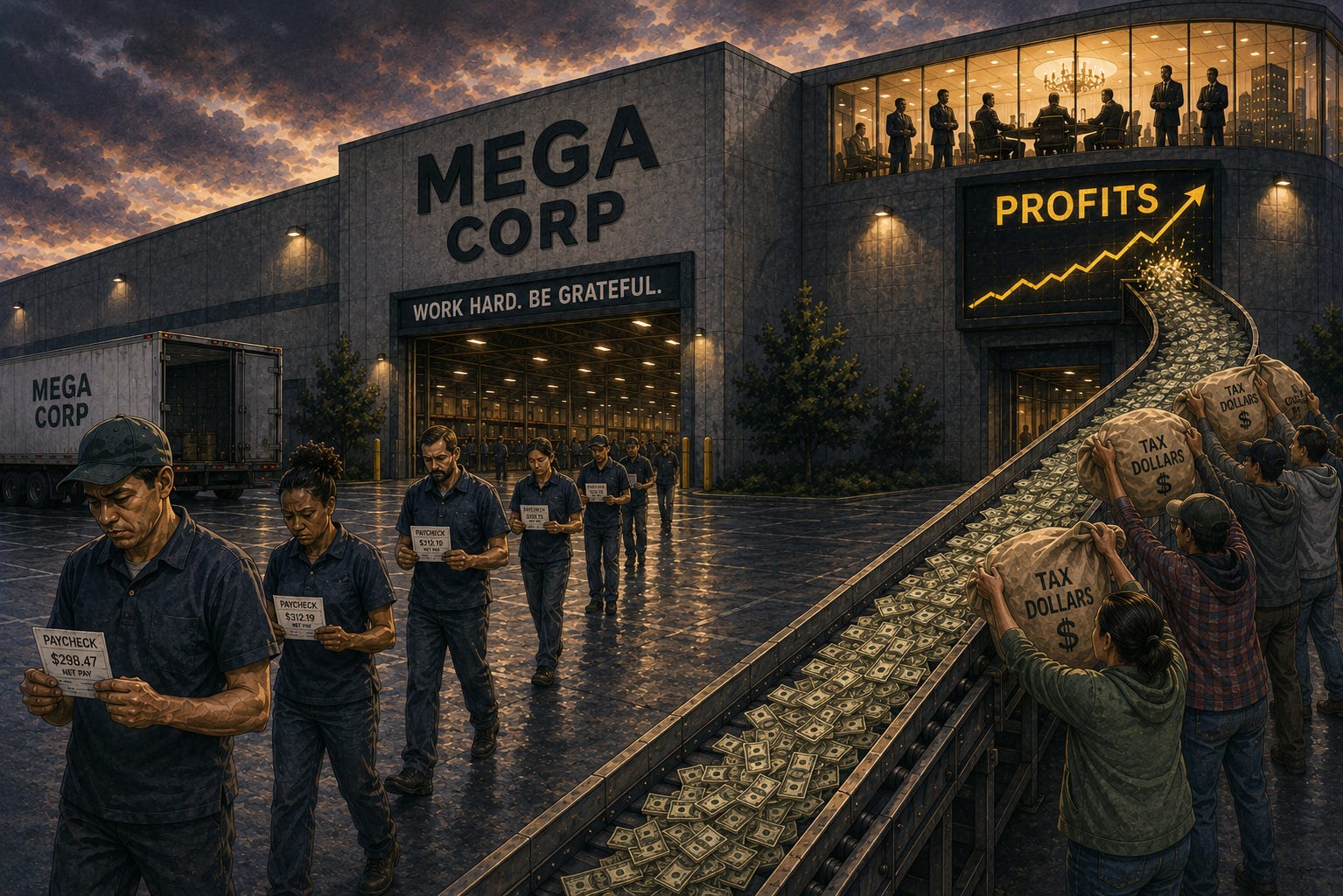
The reason raising the minimum wage has so many benefits is simple: when companies pay workers too little to afford food, rent, healthcare, childcare, and the rest of life’s expenses, the government has to step in to prevent those workers from needless suffering. Taxpayers end up subsidizing the employer through federal assistance programs for its workers.
Amazon is one of the clearest examples. A University of Illinois Chicago report found that roughly half of Amazon’s frontline warehouse workers struggled with food and housing insecurity or paying their bills. One-third rely on public assistance. Amazon had profits of roughly $80 billion last year. It also spent over $25 million on “union-avoidance” to ensure its workers couldn’t collectively bargain for better conditions and fair pay.
It should not fall on the shoulders of taxpayers to ensure that people working for the richest companies in the world have enough money to put food on the table. Those companies should be required to pay a proper wage. Minimum wage laws that enact living wages address this problem.
Despite the constant fearmongering about how higher minimum wages will destroy jobs, crush small businesses, and send prices soaring, that doesn’t happen. California recently raised the minimum wage for fast-food workers to $20 an hour, a 20% increase from the previous minimum wage. Jobs weren’t lost, and prices increased 1.5%, or six cents on a $4 menu item. Far from any of the catastrophes we were told would happen. This has been proven time and again through numerous studies of different wage increases.
Higher wages benefit businesses, too. They reduce turnover, which saves companies money on hiring and training. Worker productivity often increases. And those workers spend more money at businesses.
America even had a federal minimum wage that was a living wage in 1968. The middle class was at its strongest. GDP growth was high. Unemployment was low. The national debt was drastically lower. And people still became rich. The economy didn’t collapse because of better pay. It continued to improve.
Higher wages are more than a solution to improve workers’ lives. They are a great policy for the entire nation.
Today, the federal minimum wage is a poverty wage. This is the choice Congress made by letting it erode away for decades without addressing the problem. Finally, some members of Congress are pushing forward legislation to raise the federal minimum wage to $25 an hour over several years.
This would be an easy economic win that has far-reaching positive effects. It benefits workers, reduces poverty, improves the budget, and strengthens Social Security. It improves the economy.
The only reason not to do it is to keep caving to corporate greed.
Receipts: Higher Minimum Wages Do Not Cause Job Loss or High Prices

The federal minimum wage is a poverty wage in every state in the nation, and half of all full-time workers do not earn a livable wage. There is a simple solution to this problem. Raise the federal minimum wage to a livable wage. But whenever this is discussed, there is always an army of propagandists comprised of corporate lobbyists, industry groups, po…