

Amid renewed nuclear talks between the United States and Iran, the US has assembled its largest naval force in the Middle East since Operation Iraqi Freedom. The latest round of negotiations ended without reaching an agreement, though more talks are expected soon.
The rising tension comes just eight months after the US and Israel bombed Iran’s underground nuclear facilities. Trump insisted that the strikes “obliterated” Iran’s nuclear capabilities and dismissed reports that the attack only set back the nuclear program by a few months.
US special envoy Steve Witkoff now says that Iran is “probably a week away from having industrial-grade bombmaking materials.” It is important to understand what that actually means.
To field a viable nuclear weapon requires three separate elements: uranium enriched to weapons-grade levels, a device capable of triggering a nuclear explosion, and a delivery system such as a ballistic missile. While all related, these steps are distinct. When officials say that Iran is “a week away,” they are referring to the time needed to enrich uranium to weapons-grade levels, not the time required to design and deploy an operational nuclear weapon.
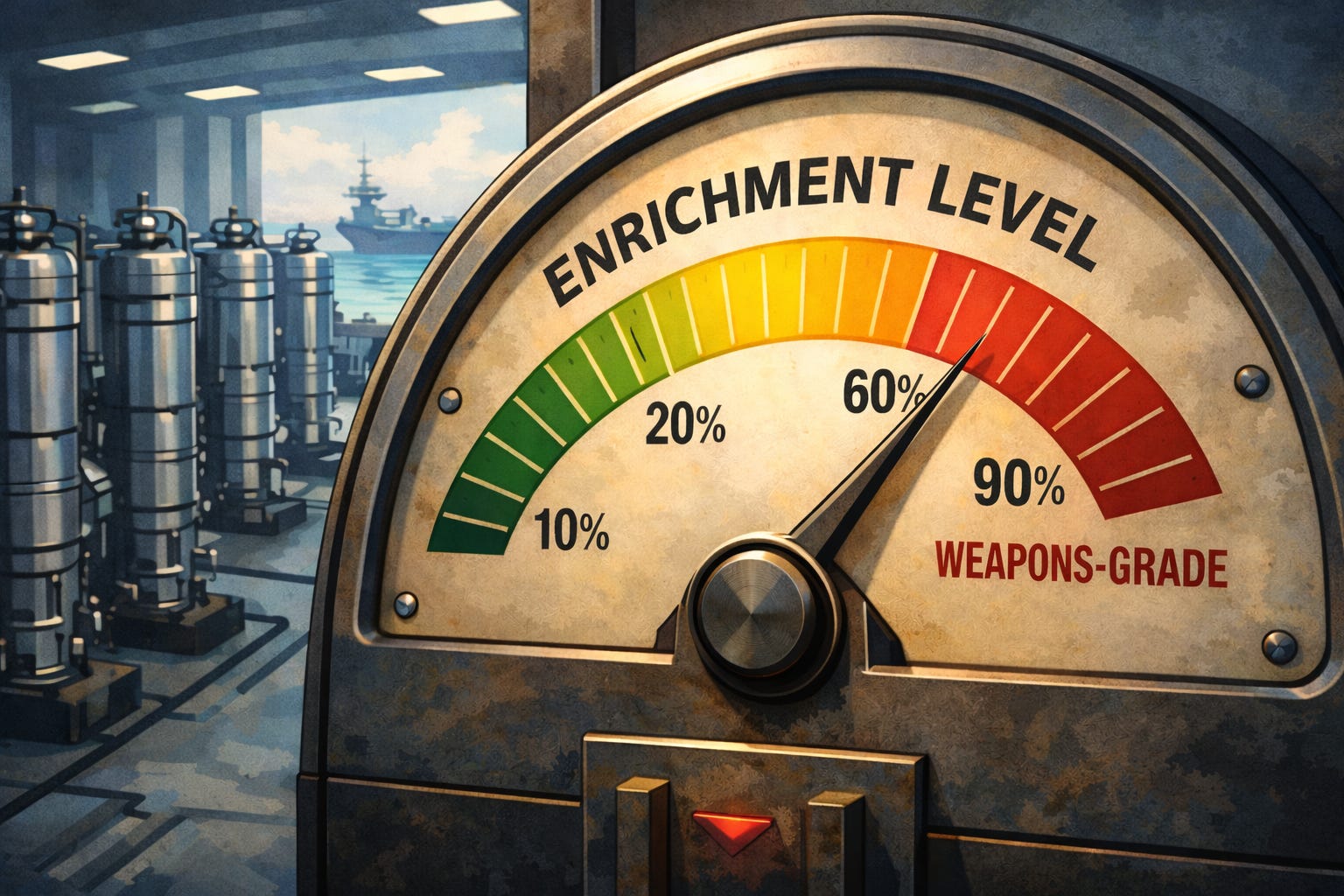
Enrichment Explained
After the last strikes, you may have heard the term “centrifuge”. Centrifuges are machines used to enrich uranium by increasing the percentage of Uranium-235. Natural uranium is mostly Uranium-238, with less than 1% U-235. Nuclear power plants require enrichment at 3-5%. Nuclear weapons require higher levels, typically at least 90%.
Iran is currently enriching uranium to 60%. Israel and the United States see this as a threat. Enriching uranium to this level requires significant technological capability, but once that threshold is reached, moving from 60% to 90% can be achieved relatively quickly. Enrichment alone does not mean a bomb is being built, and Iran is intentionally stopping at 60% when they could go further. They argue that their program is defensive, intended to show its capability and deter attacks. This level of enrichment is also reversible, should an agreement be reached.
In 2015, the United States, Europe, and Iran agreed to the Joint Comprehensive Plan of Action, or JCPOA. The deal limited Iran’s enrichment to below 4% and allowed for inspections by the International Atomic Energy Agency. In exchange, sanctions against Iran were eased.
In 2018, President Trump withdrew the United States from the agreement and reinstated harsh sanctions. Iran initially stayed within compliance after the US withdrew before gradually escalating its enrichment program to just under 20%, the limit for when it becomes classified as highly enriched uranium.
In 2021, Iran’s centrifuges were sabotaged for the second time in less than a year during efforts to revive the JCPOA nuclear deal. In response, Iran increased enrichment to 60%, sending a message about their capabilities. Iran then reduced the production rate substantially, another sign that the move was more for show than the intent of creating a weapon. Iran kept production rates low until 2025. Following more failed attempts to revive the nuclear deal and additional attacks on its program, Iran ramped up production once again.
Each step in enrichment has followed a breakdown in negotiations or a direct action against its program.
US intelligence assessments have repeatedly stated that Iran has not made the political decision to build a nuclear weapon. The concern is about how little time would be needed to enrich uranium to weapons-grade levels, not evidence of any active weapons assembly program.
Delivery Systems and Deterrence
Iran possesses one of the world’s largest stockpiles of ballistic missiles. Though none are believed capable of reaching the United States, it does have missiles that can reach Israel, which it considers to be a primary adversary. Following the June attacks, Iran launched a barrage of missiles against Israel, enough to overwhelm the nation’s missile defense systems and land several strikes. The scale of the retaliation appeared intended to demonstrate its capability without triggering a full-scale war.
That fits with Iran’s broader strategic goals.
Nuclear weapons change how countries are treated. North Korea is an oppressive regime that openly threatens the United States, yet it has not faced a direct military strike in the way Iran has. North Korea has nuclear weapons and intercontinental ballistic missiles. The cost of attacking it is unpredictable and could be catastrophic.
Russia’s invasion of Ukraine is another example of how nuclear status shapes global responses. Russia is a nuclear power. NATO and the United States provided substantial support to Ukraine but imposed limits on how those weapons could be used, and have carefully avoided direct confrontation with Russian forces. The risk of nuclear escalation, no matter how unlikely, influences every decision.
Ukraine once inherited the world’s third-largest nuclear arsenal after the dissolution of the Soviet Union. It agreed to transfer those weapons to Russia in exchange for security assurances from the US and Russia under the Budapest Memorandum. Decades later, Ukraine was invaded by one of the countries meant to provide it security, while the US was slow, careful, and measured in its response.
Why This Matters
Iran is an oppressive regime with a long record of human rights abuses and support for militant proxies. There are legitimate concerns about its behavior in the region. But the current standoff is not primarily about whether Iran would immediately use a nuclear weapon. It is about leverage. Once a country crosses the nuclear threshold, even if it never fires a shot, it becomes harder to restrain or attack.
The world has demonstrated that countries with nuclear weapons operate under a different set of constraints than those without them. Iran’s enrichment program, especially at 60%, signals that it wants to gain that extra leverage.
If Iran crosses the nuclear threshold, other regional powers such as Saudi Arabia could pursue similar capabilities, triggering an arms race. That is the core of the conflict: how possession, or near-possession of a nuclear weapon, reshapes the balance of power in the region.
https://www.sipri.org/commentary/essay/2021/why-iran-producing-60-cent-enriched-uranium
It Was Never About Drugs

America launched a military operation to attack Venezuela’s capital and abduct its president to face trial in the United States.
Thanks. Very clear writing. For me, the better question is: why should other countries have nuclear weapons? If it's not good for Iran why is it OK for North Korea? India? Pakistan? Israel? China? Russia? The European countries? Why is it OK for the US? Do we have some kind of moral high ground - we don't anymore if we ever did? Only the powerful are allowed nuclear weapons. Why do we have a say what happens inside sovereign borders? We can exert pressure. But it's not ultimately our decision.