

The world’s most powerful military needed to ask its allies for help in a war it started against a much smaller and technologically inferior opponent. Oil markets have spiraled to the point that sanctions are being lifted against a nation committing war crimes just to slow the rising gas prices. An economy once called the envy of the world has stalled, with job growth disappearing and prices rising. And a president who claims sweeping authority is now being constrained by the very courts he helped shape.
Trump presents himself as a figure of strength. To much of the world, he looks increasingly weak and desperate. These aren’t isolated incidents. They are a pattern.
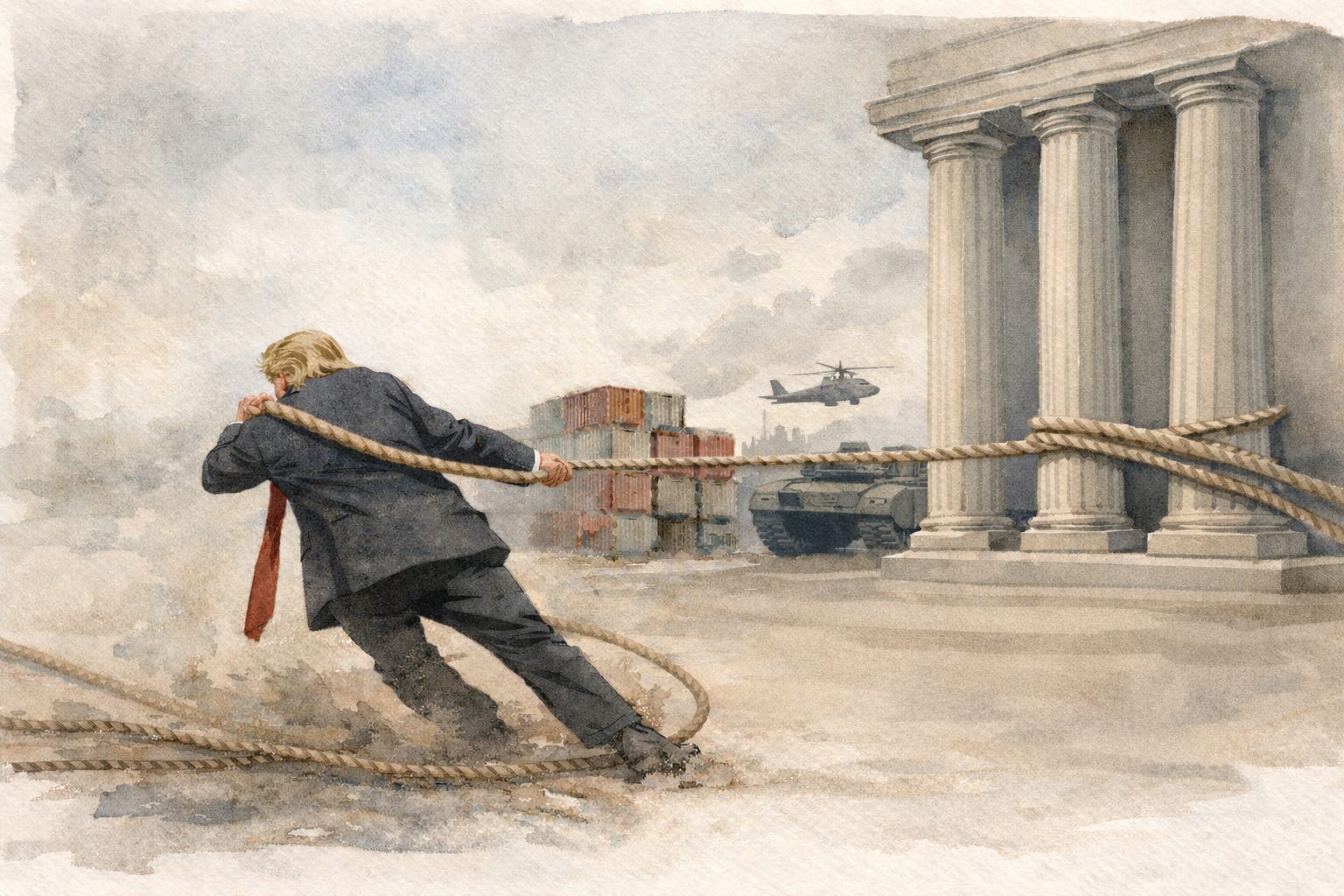
On February 28th, U.S. and Israeli forces launched attacks on Iran aimed at eliminating its leadership and degrading its military. Trump did not consult key allies or seek congressional approval, as required by the Constitution, continuing a series of unilateral decision-making that has marred much of his presidency.
The initial announcement of the attack and the following press conferences showed overconfidence. Previous actions, including earlier strikes on Iran and the successful removal of Venezuela’s leader, reinforced the administration’s belief that escalation would be limited and manageable.
Iran did not fold. It retaliated.
It struck U.S. bases. It struck Israel. It struck oil infrastructure. And it moved to shut down the Strait of Hormuz, a chokepoint that carries roughly 20% of the world’s oil supply. Oil prices surged past $100 a barrel. Gas prices jumped. Markets dropped. Iran cannot match the United States militarily, but it can disrupt the global economy.
Disruption of the Strait of Hormuz is one of the most widely discussed outcomes in any conflict with Iran. Yet the administration appeared caught off guard. In response, Trump turned to the same allies he hadn’t consulted before starting the war. The same ones in an alliance he had threatened to abandon. The same ones he had just hit with tariffs.
He asked them to send forces to help reopen the Strait and even announced that a coalition would step in to deal with Iran before any of those nations responded.
Then they declined.
One after another, each nation refused to send help. They didn’t start this war, and they had no interest in joining it. NATO is a defensive alliance, not an offensive one, and the United States had not been a reliable partner in the lead-up to the conflict. There was no reason for them to get involved.
Trump responded by insisting he didn’t need their help anyway. That pattern—acting alone, then seeking support, then dismissing it when it doesn’t go his way—has become a defining feature of his presidency.
Ukraine has developed impressive capabilities to counter Iranian-style drone warfare during Russia’s invasion. Last year, it offered to share that expertise with the United States and warned about the growing risk of drone-driven conflicts.
The administration declined.
After Iranian drone attacks killed seven U.S. servicemembers and forced costly defensive responses, the United States turned back and asked Ukraine for the help that was previously refused.
Even as the United States was seeking assistance from Ukraine, Trump was escalating tensions with its leadership.
Trump has been frustrated with Zelenskyy since failing to deliver on his promise to end the war in Ukraine in 24 hours. Instead of directing that frustration at Russia, which launched the unprovoked invasion, he has repeatedly criticized Ukraine for refusing to accept a deal that would have required giving up territory and weakening its position against future attacks.
That tension spilled over again, with Trump publicly dismissing Ukraine’s help, even as its expertise could save American lives. Dismiss the risk, reject the help, then scramble when the consequences arrive. The cycle repeats.
American weakness isn’t limited to conflicts abroad.
Over the past year, tariffs imposed on allies and trading partners have weighed on economic growth. Job creation hasn’t just stalled; it has reversed, with thousands of jobs lost over the past 10 months instead of millions created. Manufacturing has declined. Farm bankruptcies have increased. GDP growth has slowed to just 0.7% in the most recent quarter.
The combination of war-driven market disruptions and a self-inflicted economic slowdown has turned an economy that was once the envy of the world into a case study in what not to do.
Domestically, the limits of Trump’s power have become more visible.
Courts have repeatedly ruled against the administration. They have blocked major policies, declared key tariffs illegal, and stopped attempts to use government power for political retaliation. Even the Trump-appointed U.S. Attorney for New Jersey was removed by the courts for unlawfully serving by bypassing Senate confirmation.
Even within his own party, Trump has struggled to push through priorities, including the SAVE Act, despite Republican control of Congress. Lawmakers are increasingly wary of being tied too closely to an administration that is losing ground politically.
Since Trump took office, Democrats have flipped seats across the country, and the midterms are shaping up to be a significant blowback to the GOP, with a loss of the House majority all but guaranteed.
There is a lesson to be learned in all of this. Strength is not defined by acting alone. It is defined by outcomes, by alliances, and by the ability to shape events without losing control of them. This requires not just military force, but soft power and cooperation.
Trump set out to project dominance on the world stage. Instead, he has exposed how limited his power is and how easily his demands can be resisted.
The world is watching. And what it sees is not strength.
https://www.axios.com/2026/03/10/us-ukraine-anti-drone-offer
America Is Weaker Alone

The United States may have the most powerful military, the largest economy, and the greatest world influence, but that hasn’t always been the case and could easily change.