

The Secretary of Defense says it’s a war. The President says it’s a war. American forces are fighting and dying in the region. Yet many Republicans insist it isn’t a war at all.
The United States, alongside Israel, launched coordinated attacks across Iran, striking numerous sites and killing its leader. The Secretary of Defense said, “The United States is prevailing in this war.” Trump warned that American lives may be lost because “that often happens in war.”
Other Republicans are taking a different stance. Speaker of the House Mike Johnson said, “We are not at war right now. We’re four days into a very specific, clear mission.” Senator Markwayne Mullin said, “This isn’t a war. We haven’t declared war.”
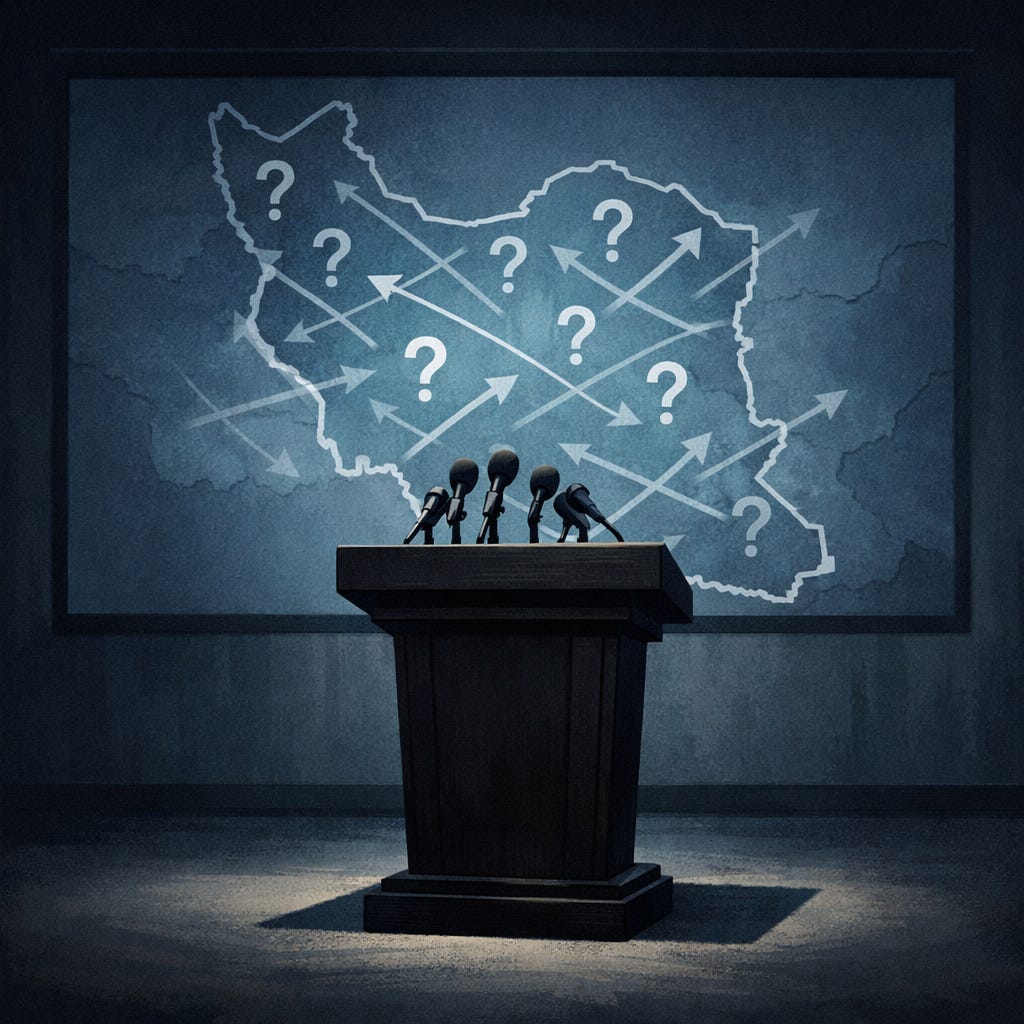
The debate over whether to call this a war reflects a deeper problem: the Trump administration has offered a series of shifting explanations for why the United States attacked Iran, what the objective is, and how long this conflict could last.
Only Congress has the power to take our nation to war. Admitting this is a war would also mean admitting that Trump violated the Constitution when he started this conflict.
By calling it a special military action, Republicans hope to rely on the War Powers Act, which allows the President to use military force in some cases without first obtaining permission from Congress. But a critical requirement of the War Powers Act is that there must be an immediate threat posed to the United States or its interests.
There wasn’t one.
Iran was in negotiations with the United States about its nuclear program. There had been no attacks from Iran since the ceasefire following the previous strikes by the United States and Israel in June—strikes that Trump said had “obliterated” Iran’s nuclear program. By that account, the nuclear program couldn’t be an imminent threat either. And Iran doesn’t possess ballistic missiles capable of reaching the United States.
The Trump administration has been tripping over itself trying to explain its justification for this war.
Initially, reporters were briefed that intelligence felt there was an imminent threat of attacks against US bases in the Middle East. Then Marco Rubio briefed the press:
“We knew that there was going to be an Israeli action. We knew that that would precipitate an attack against American forces, and we knew that if we didn’t pre-emptively go after them before they launched those attacks, we would suffer higher casualties.”
Those comments immediately set off a firestorm. The idea that America went to war not because of any imminent danger, but because an ally was determined to strike Iran amid ongoing negotiations, created outrage.
The Trump administration attempted to backpeddle, with Trump saying that it wasn’t because of Israel:
“We were having negotiations with these lunatics, and it was my opinion that they were going to attack first. They were going to attack. If we didn’t do it, they would have attacked first. I felt strongly about that.”
Rubio was sent back out in front of reporters to change his position. He now said that Israel did not force Trump’s hand and that these attacks needed to happen because Iran was hiding behind its ballistic missile program.
The administration hasn’t given a convincing response to the goal of this war. We were told it was about regime change, only to be told it wasn’t. They said it was because of the risk of Iran getting a nuclear weapon, only to admit that Iran wasn’t even working on a weapon. The most recent reasoning given is that Iran’s missile programs, nuclear program, and navy must all be destroyed to bring security to the region.
While the administration struggles to explain why the war began, the consequences are already here. Iran retaliated. Six US servicemembers have been killed. Others were seriously wounded.
There have been deaths in Kuwait, Israel, the UAE, Lebanon, Bahrain, and Iran. Cargo ships and oil facilities have been attacked. Multiple US bases have been hit. Protesters rushed the US embassy in Pakistan, leaving more than 20 dead.
The death toll has passed 1,000. At least 100 of those killed were Iranian girls when an elementary school was struck on the first day of the war.
Even the timeline is unclear. At first, we were told the war might last two or three days. Then a week. Then four to five weeks. Then maybe eight. Most recently, Trump said the United States has the supplies to fight forever.
This came as questions were raised about the stockpiles of missile interceptors. These advanced weapons have been sent to Ukraine, were used in June during Iran’s retaliatory strikes after its facilities were bombed, and are being used today. Supplies are not infinite, and these missiles are not cheap. While the US has military dominance over Iran, the question is whether we’d have the supplies needed for another war, and if being involved in this conflict emboldens adversaries elsewhere, such as with China and its desire to retake Taiwan.
That is what this war has brought more than anything else: confusion. Why did we go to war while negotiations were ongoing, Iran wasn’t building a nuclear weapon, and there was no imminent threat? Why wasn’t this war debated in public as the Constitution intends and voted on by Congress like the Iraq and Afghanistan wars were? What is the goal of this war? What does victory look like, and how long will it take?
The administration cannot clearly explain why the war started, what the objective is, or how long it will last, yet the bombs are falling anyway, and Americans are largely against it.
https://www.theguardian.com/us-news/2026/mar/03/trump-israel-iran-war
Understanding the US-Iran Nuclear Standoff

Amid renewed nuclear talks between the United States and Iran, the US has assembled its largest naval force in the Middle East since Operation Iraqi Freedom. The latest round of negotiations ended without reaching an agreement, though more talks are expected soon.