

The White House is celebrating today’s job report, pointing to 130,000 jobs added in January. It is the strongest monthly gain of Trump’s second term so far.
Job gains are a good thing, but it is important to keep this in context.
This report is an early estimate. These numbers will be revised multiple times in the coming year. Sometimes revisions go up. Sometimes they go down. We won’t know for a while where January truly lands.
What we do know is that the same report included major revisions to 2025 and late 2024, and they were ugly.
Instead of meaningful growth, all of last year — 2025 — saw just 181,000 jobs added in total. That’s about 15,000 per month. For comparison, the 2015-2019 average was roughly 190,000 per month. From 2021 to 2024, the average was around 235,000. And in 2024, with today’s revisions, over 100,000 jobs were created per month.
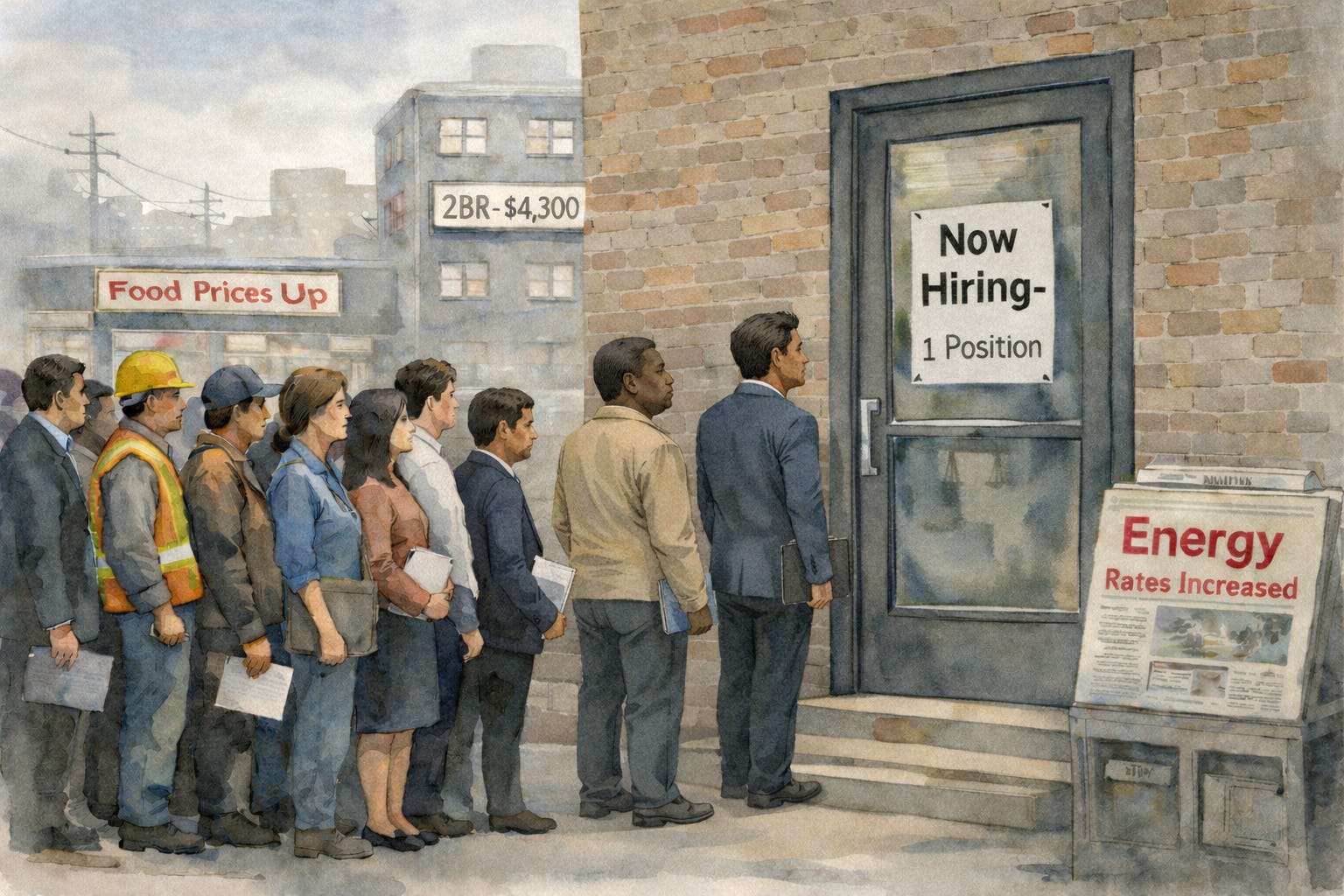
From over 100,000 jobs per month to 15,000 in one year. The job market has stagnated.
Beyond The Headline Number
A healthy job market isn’t defined by a single monthly figure. It shows up as:
Low unemployment
More job openings than job seekers
Wages rising faster than costs
Last year, we moved in the opposite direction.
Unemployment rose from 4.0% to 4.3%. The number of unemployed Americans climbed from 6.9 million to 7.4 million. By the end of the year, there were more unemployed workers than job openings.
Hiring slowed. Job switching disappeared. Layoffs shot up to 1.1 million over the course of the year, a 54% increase from the year before and the highest since the peak of the pandemic in 2020. This is what a weak and slowing job market looks like.
Wages “Beat Inflation” — But That’s Not the Whole Story
On paper, average wages grew slightly faster than overall inflation in 2025. That sounds encouraging. But averages can hide a lot.
Low-wage workers saw their real wages, wages adjusted for inflation, fall by 0.3%. That’s a hard reversal from 2019 to 2024, where those workers saw their wages rise faster than any other group.
The other 90% of workers saw roughly a 1% real wage gain. But that figure is measured against overall inflation, which includes categories that don’t weigh equally on working families.
Prices that rose faster than average inflation last year included:
Food
Electricity
Home heating
Housing
Healthcare
Auto repair and maintenance
When everyday expenses outpace your wage gains, it doesn’t matter that televisions cost less.
People don’t experience “core CPI.” They feel the pinch of grocery receipts and rent increases. That disconnect is why, no matter how often Trump calls affordability a hoax, the American people are upset at how poorly he has handled the economy.
Where the Jobs Are — and Aren’t
The January gain of 130,000 jobs followed the trend of the past year, in which almost all the jobs created were in private education and healthcare. Outside of that, the broader job market was contracting. Manufacturing has now lost jobs for nine straight months, a slide that began after tariffs were enacted on “Liberation Day.”
Blue-collar workers have taken the brunt of this change, with over 100,000 jobs in manufacturing, construction, and other blue-collar industries lost in 2025.
So while the headline number looks alright, life tells a different story. Growth is limited, and losses are concentrated in sectors that matter deeply to working-class communities.
A Two-Speed Economy
One area is strong: asset markets. The stock market continues to climb. Corporate profits remain at record highs. Wealthy households, which hold the majority of financial assets, are benefiting greatly.
Consumer spending has increasingly relied on the top 10% of earners, who own 90% of all stocks. Their investment gains give them room to keep spending. The rest of America is cutting back and relying more on debt to get by. Credit card balances now exceed $1.2 trillion.
A relatively small share of Americans is doing extremely well. Most others are fighting hard to tread water, and some are slipping beneath the surface.
Should We Celebrate 130,000?
Even if January holds at 130,000 jobs after revisions, it’s hard to call that impressive.
It follows a year that averaged 15,000 per month. It trails the job creation seen in the pre-pandemic expansion, the post-pandemic recovery, and the return to normalcy. And, worst of all, it is heavily concentrated in just two sectors.
This is mediocrity dressed up as momentum.
What Would Actually Improve The Job Market
There is a clear, straightforward way to defrost the job market and turn the economy around.
Invest in America.
Invest in domestic manufacturing rather than disrupting supply chains with unpredictable tariffs
Expand infrastructure and clean energy projects that create high-wage jobs
Support emerging technologies without igniting trade wars that raise consumer costs
Strengthen labor markets instead of relying on stock markets to drive spending
Trade wars raise costs for businesses and consumers. They suppress domestic investment and slow hiring in industries that depend on global markets. The way to make America’s economy stronger isn’t to try to hurt other nations’ economies; It is to invest in our own to make it more competitive.
The Underlying Problem
Correcting our course isn’t hard, but there is one major hurdle: admitting mistakes.
Tariffs were a mistake. Ignoring the warning signs is another. Calling people’s affordability struggles a hoax only deepens the problem. Cutting investment in future industries makes recovery harder.
Mistakes happen, but unless we admit them and address them, we can't expect the economy to return to firing on all cylinders and bring prosperity to the nation.
https://www.epi.org/blog/low-wage-workers-faced-worsening-affordability-in-2025/
https://www.bls.gov/news.release/empsit.nr0.htm
American Capitalism Has Been Hijacked

750,000 are homeless, 27 million lack health insurance, 36 million live in poverty, 42 million rely on federal food assistance, Social Security’s surplus is running out, the nation has racked up $1.2 trillion in credit card debt, and people are resorting to Buy Now, Pay Later loans to buy groceries.