

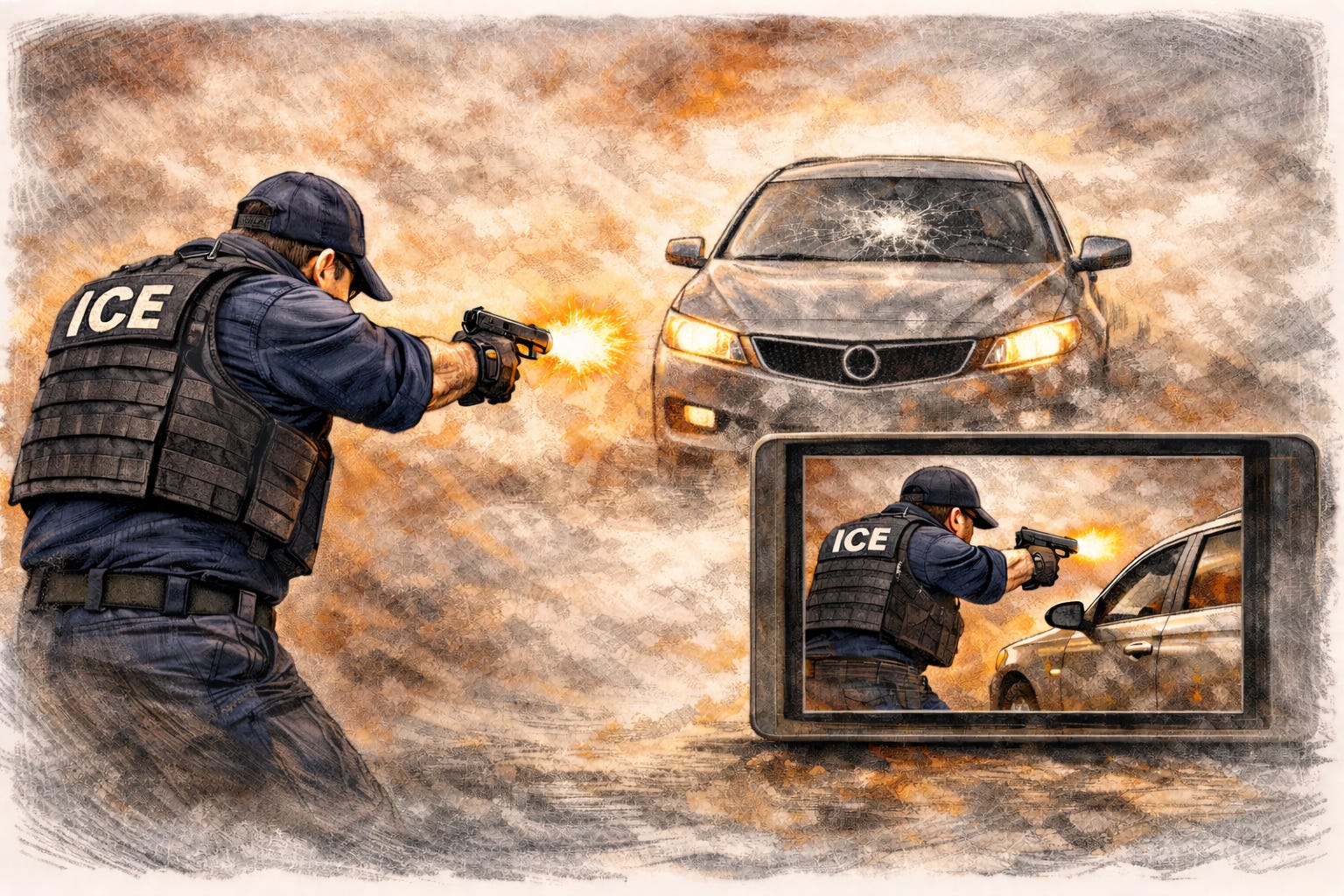
Today in Minneapolis, ICE agents exited their vehicles to approach the stopped car of a 37-year-old woman. Videos recorded by bystanders did not show her posing an immediate threat to them.
The woman backed her vehicle up, then appeared to turn it away from officers and attempted to leave the scene. One agent tried to force open the driver’s side door. Another agent fired at least two shots — one at the front of the vehicle and at least one more through the driver’s side window. She was struck in the head and died at the scene.
The Department of Homeland Security quickly released a statement in an apparent effort to control the narrative:
“Today, ICE officers in Minneapolis were conducting targeted operations when rioters began blocking ICE officers and one of these violent rioters weaponized her vehicle, attempting to run over our law enforcement officers in an attempt to kill them—an act of domestic terrorism.
An ICE officer, fearing for his life, the lives of his fellow law enforcement and the safety of the public, fired defensive shots.
He used his training and saved his own life and that of his fellow officers.
The alleged perpetrator was hit and is deceased. The ICE officers who were hurt are expected to make full recoveries.
This is the direct consequence of constant attacks and demonization of our officers by sanctuary politicians who fuel and encourage rampant assaults on our law enforcement who are facing 1,300% increase in assaults against them and an 8,000% increase in death threats.
This is an evolving situation, and we will give the public more information as soon as it becomes available.”
President Trump echoed this account, claiming that a woman screaming during the incident was a paid agitator, that the driver had “run over” an ICE agent, and that the incident was the fault of the radical left.
The problem for DHS and Trump is that multiple people filmed the entire encounter.
What those videos show is starkly different:
There were no rioters.
Reviewing multiple recordings, the driver appears to turn the vehicle away from agents rather than toward them, undermining DHS’s claim that officers were under immediate threat.
No footage shows any agents injured. The agent who fired the shots remains upright and moves unimpeded immediately afterward.
The woman was killed during the encounter — an outcome now under investigation amid serious questions about the agent’s use of force.
This incident fits a broader pattern. ICE has increasingly engaged in what can only be described as thuggish behavior, including repeated cases in which agents fired on vehicles under circumstances later undermined by recorded evidence. In multiple documented instances, DHS issued rapid public statements that failed to align with what cameras later revealed.
In October of last year, Border Patrol agents claimed that Marimar Martinez attempted to ram their vehicle, resulting in Martinez being shot multiple times. DHS described the incident this way:
“After striking the agents’ vehicle, the defendants’ vehicles boxed in the agents’ vehicle, the complaint states. The agent was unable to move his vehicle and exited the car, at which point he fired approximately five shots from his service weapon at Martinez, the complaint states.”
Body-camera footage described in court filings told a different story. The video showed Border Patrol agents turning their vehicle toward Martinez’s car, contradicting claims that she initiated the collision — a discrepancy so significant that federal prosecutors later dropped the charges. After the shooting, the officer involved sent a message to colleagues that read: “I fired 5 rounds and she had 7 holes. Put that in your book boys.”
In another vehicle-related incident, ICE agents approached Silverio Villegas-Gonzalez shortly after he dropped his 3-year-old son off at daycare. The agents were not wearing body cameras, but nearby surveillance footage captured the encounter, and responding local police officers later recorded body-camera video.
DHS claimed:
“ICE officers conducted a vehicle stop to arrest Silverio Villegas-Gonzalez. He refused to follow law enforcement’s commands and drove his car at law enforcement officers. One of the ICE officers was hit by the car and dragged a significant distance. Fearing for his own life, the officer fired his weapon.”
Surveillance footage and police body-camera video later raised serious questions about that account. Officers parked at an angle in front of Gonzalez’s vehicle and approached from both sides. As in the Minneapolis case, they attempted to force open his door. Gonzalez backed up slightly. An officer reached into the partially open driver’s window, and when Gonzalez drove forward, the officer was pulled with him. Two shots were fired, and Gonzalez was killed.
Contrary to DHS’s statement, police body-camera footage recorded after the shooting shows the officer saying he had been “dragged a little bit” and that his injuries were “nothing major.”
Law-enforcement experts cited by NBC News have described these tactics as reckless. Officers are trained not to block vehicles at angles and never to reach into moving cars precisely because doing so can result in being dragged or seriously injured.
ICE agents’ tactics repeatedly escalate encounters instead of de-escalating them, undermining the basic purpose of law enforcement: community safety. Firing on fleeing vehicles turns those cars into uncontrolled hazards that can injure or kill bystanders.
Axios has documented a broader pattern of false or misleading DHS statements, linking video evidence and court records that later contradicted official claims. Among them:
DHS commander Greg Bovino initially claimed he was struck by a rock before deploying tear gas; he later admitted he was hit after throwing the gas.
DHS alleged protesters were firing artillery-style fireworks at agents; body-camera footage showed the explosions came from DHS flashbang grenades.
Protester Cole Sheridan was charged with assaulting Bovino, only for video to later show that Sheridan was the one assaulted; the charges were dropped.
Axios identified 12 DHS claims during a single operation that were later contradicted by video or court findings. Reporting on other DHS operations has uncovered similar discrepancies.
This pattern of aggressive federal policing reflects leadership that has repeatedly endorsed violence as a political tool. Trump deployed the National Guard in multiple cities as a form of intimidation. During his first presidency, reports emerged that he asked why immigrants crossing the border couldn’t be shot in the legs. In response to the George Floyd protests, he declared, “when the looting starts, the shooting starts.” Former officials, including Mark Esper, have said Trump questioned why protesters could not simply be shot. And when he lost the election, he incited supporters to attack the Capitol.
This is what the early stages of tyranny look like. If it is not confronted loudly and unwaveringly, the United States risks beginning to resemble authoritarian systems like Russia — where violence is used against dissenters and elections are manipulated to maintain power.
https://www.axios.com/local/chicago/2025/12/08/dhs-claims-contradicted-video-court
https://www.axios.com/2022/05/02/trump-call-violence-presidency