

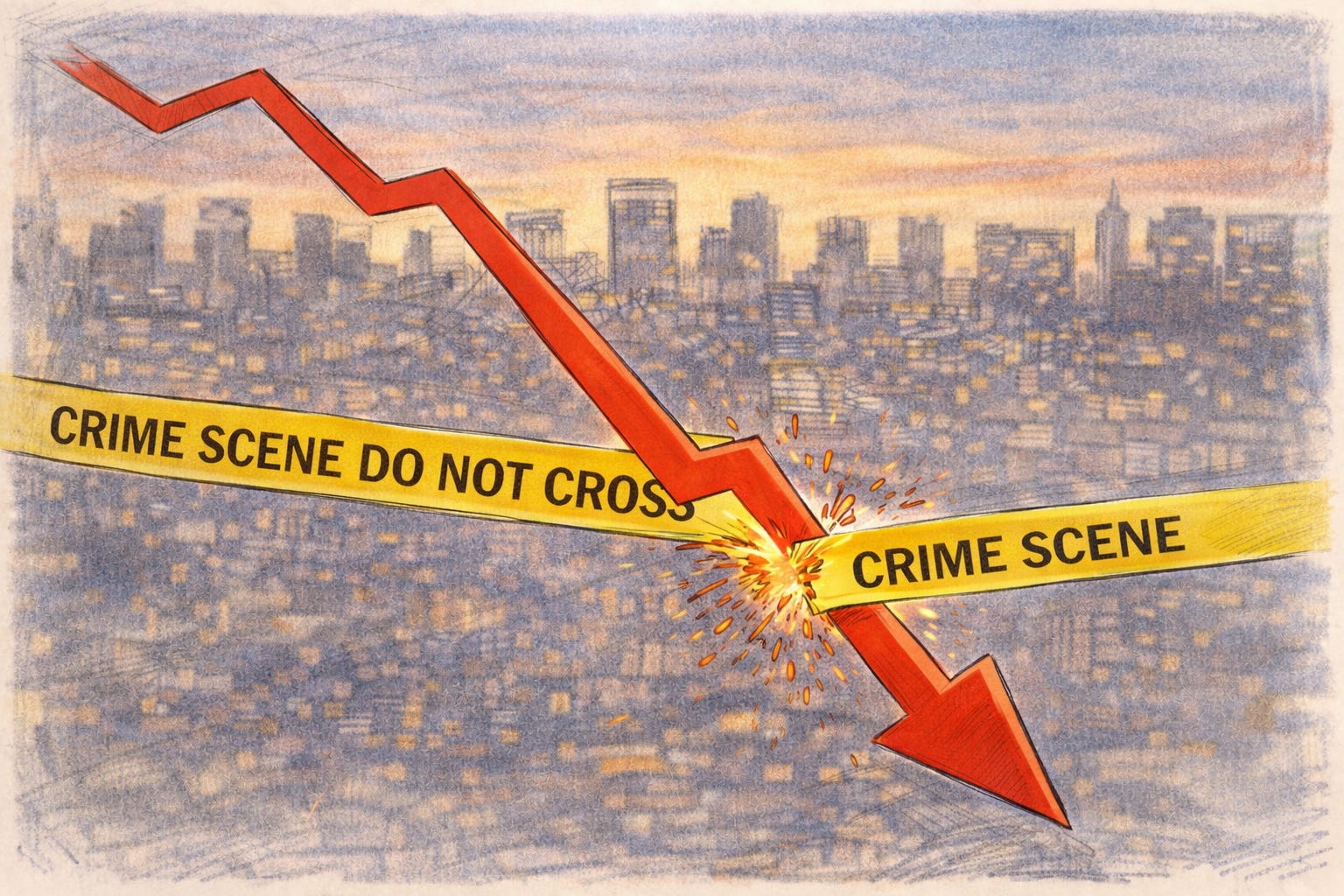
2025 was a challenging year marked by political violence, rising costs, global conflicts, the longest government shutdown in history, and an ongoing healthcare crisis. But there is one bright spot among all the difficulties: America saw the largest one-year drop in homicides in history.
That’s according to data from the Real Time Crime Index. The FBI will release its complete 2025 crime data next year, but the data released so far tracks closely with the RTCI.
Crime reduction isn’t a new trend. 2023 set the record for the largest one-year drop in homicides; 2024 broke it; and 2025 has broken it again. And it isn’t just homicides.
All crime indexes nationwide have decreased significantly over the last two years. Violent crime, property crime, burglary, theft, it all keeps going down. The Gun Violence Archive shows gun deaths (excluding suicides) decreased 13% this year, and mass shootings by 20%. Both categories are now below pre-pandemic levels.
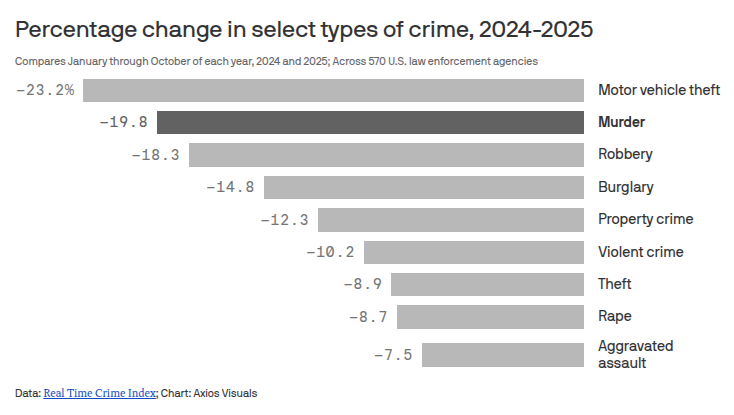
This should be a bigger story, as it should have been last year. We’re past recovering from the crime spike of the pandemic and continuing to see crime rates drop rapidly, with some cities seeing categories hitting their lowest point in 80 years. For all the other issues we may be dealing with in America, we are living in a time of historically low crime.
Unfortunately, crime is one of the most politicized issues, so it is often exaggerated and lied about to scare voters. A common disinformation point in 2023 and 2024 was that major cities like New York and Chicago weren’t reporting their crime rates, which is why FBI data showed such significant decreases. That lie took hold, even though the FBI data is public and anyone could see for themselves that the reports from major cities were there.
Another disconnect is that people believe what they see, and what they see is news stations showing videos of crimes every night, making it feel like an out-of-control problem. This misleading narrative is pervasive among certain partisan networks when the opposing party is in power.
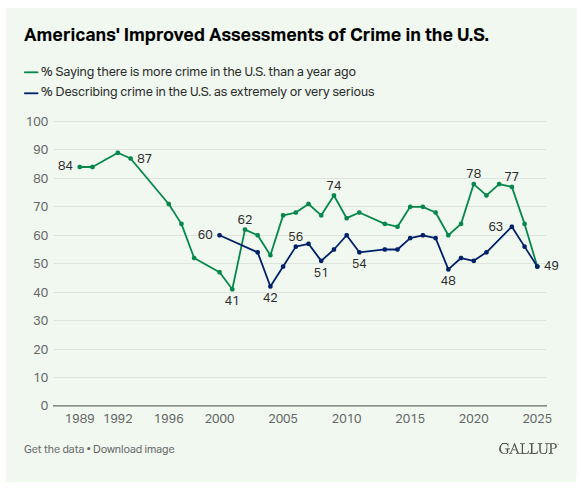
Public perception is finally catching up to reality. In 2023, 77% of Americans thought crime was getting worse, even though it was getting better; in 2024, that perception was down to 64%, and this year it dropped to 49%.
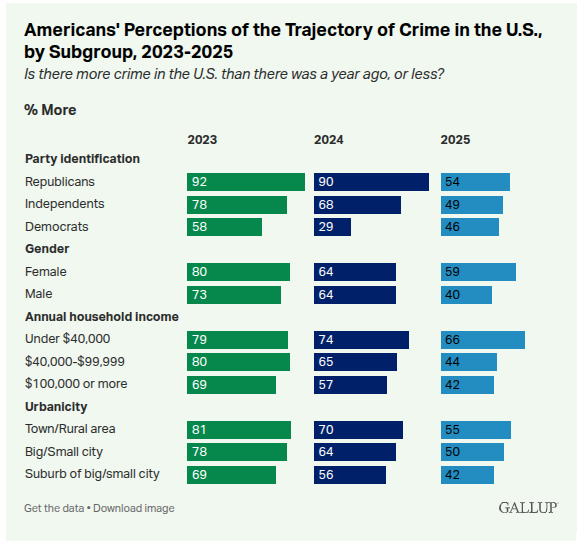
Partisanship influences perception. Despite historic reductions in crime in 2024, 90% of Republicans thought crime was getting worse compared to only 29% of Democrats. This year, as control of the government switched from blue to red, Republicans dropped to 54% believing crime is worsening, while Democrats rose to 46%. Everyone wants lower crime, so let’s stop lying about it based on who is in power.
While nationwide crime saw a significant reduction, some places saw even greater declines, such as Chicago, which had a 29% decrease in homicides.
Efforts used in Chicago to combat crime are also in use across the country, such as the Crisis Assistance Response and Engagement (CARE) program, which uses mental health clinicians and EMTs to respond to non-violent emergency calls involving behavioral health crises. This approach improves the results of those calls and provides follow-up care to ensure community safety.
Another program, Rapid Employment And Development Initiative (READI Chicago), provides jobs for high-risk individuals to keep them away from crime and help them get on a path to better opportunities.
These programs, along with 48 others in Chicago that address community safety, homelessness, mental health, human rights, and government improvements, can be viewed on the city’s dashboard. Hundreds more of these programs are active nationwide, and they get results.
But here’s the first concern with this good news: the federal government primarily funds these programs through the American Rescue Plan passed in March 2021. That funding expires at the end of next year. Cities may not be able to afford to keep these programs running, or at least not at their current scale, without that additional federal funding. If the economy worsens, funding will be even more at risk.
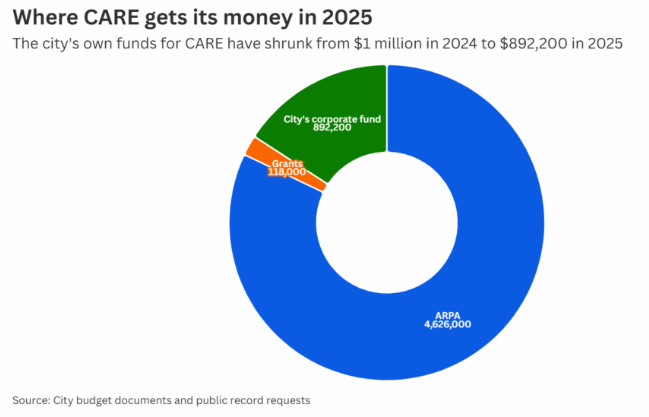
The American Rescue Plan was a solid implementation that didn’t attempt to direct states specifically how to use the funding they received. Instead, there were a few key restrictions on how the money was to be used, and states were encouraged to spend it on public safety. This approach allowed each state to enact programs that best served its needs.
Beyond the direct reduction in crime, these programs have ripple effects, such as freeing up police resources to focus on other issues. Chicago restructured its detective bureau, improved its technology, increased staffing in forensics, and created new departments to reduce the evidence-processing backlog. The result is a homicide closure rate that is the highest in over a decade.
What we see is a commonsense blueprint for reducing crime: investing in police, community services, and modern technology, along with adopting proven data-driven methods for crime prevention and completing investigations. That is part of what the American Rescue Plan gave to the nation.
Government spending is an essential driver of our safety, security, and prosperity. It isn’t something to reduce simply because you can; instead, government programs must be routinely evaluated to ensure they deliver the maximum benefit at the lowest cost. It is about efficiency and effectiveness, not size. That is the type of government we need more of.
We need less of the government that makes cuts to critical programs to funnel money to billionaires and commits crimes of its own. And we desperately need more bipartisanship in Congress. The results of the American Rescue Plan are impressive, but not one single Republican voted to pass it.
The midterms are an opportunity for the people to fire the politicians who aren’t working for them and to hire the ones who will. Let Congress know what you expect them to deliver and that your vote is on the line if they do not.
The Incredible Value of Preschool

As I dropped my four-year-old daughter off for her first day of school, the beginning of Pre-K, I experienced the usual emotions that parents feel as they reach this milestone of their child being away from home for the first time. But there was another thought on my mind the whole drive home: