

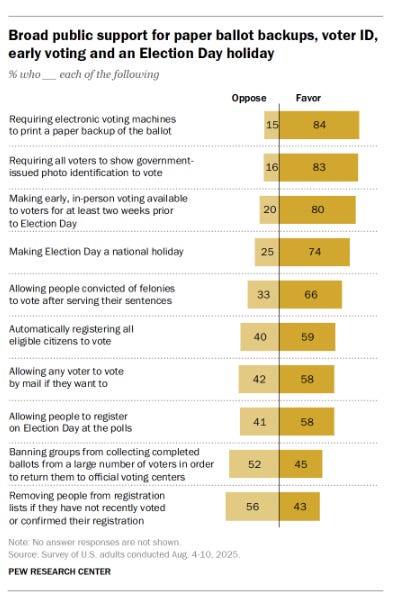
Polling consistently shows that more than 80% of Americans support requiring a photo ID to vote. That support crosses party lines, with majorities of Republicans, Democrats, and independents in agreement.
So why has a federal voter ID law become so controversial? Because popularity alone does not make a policy workable, constitutional, or just.
To understand why, we need to start with an important fact that has been deliberately lied about for years.
America Does Not Have a Voter Fraud Problem
Despite relentless claims to the contrary, the United States does not have a voter fraud problem. This has been examined repeatedly from every ideological angle, and it simply is not happening.
After the 2020 election, Donald Trump and his allies filed dozens of lawsuits alleging fraud. They were dismissed, over 50 of them in total, due to a lack of evidence. Recounts were conducted. Audits followed. Investigations at the state and federal levels reached the same conclusion again and again: the election was secure.
Even the Heritage Foundation, one of the most conservative think tanks in the country and a central player in Project 2025, maintains a database tracking voter fraud. Looking at 50 years of data, it found so few cases of non-citizens registering to vote, voting, or attempting to vote that it averaged less than one per year, and only 10 cases of in-person voter impersonation nationwide, out of hundreds of millions of votes.
Other investigations tell the same story. The Brennan Center found voter fraud rates as low as 0.0003%. A Department of Justice review of past elections found fraud at a rate so low as to be effectively nonexistent.
America does not have a voter fraud problem. It has a sore loser problem. And this matters because voter ID laws are being justified as a solution to a problem that does not exist.
Voter ID Laws Create More Harm Than Security
When fraud is vanishingly rare, adding new voter ID laws only makes it harder for legitimate voters to cast their ballots.
Even judges who once supported these laws have acknowledged this fact. Former conservative judge Richard Posner, who upheld Indiana’s voter ID law, later reversed his position and stated that strict voter ID requirements are now widely understood as tools of voter suppression rather than fraud prevention.
And that is exactly how voter ID laws are being used.
Republican lawmakers in multiple states have pushed to ban student IDs as valid voter identification. Indiana, Idaho, Arizona, North Carolina, and New Hampshire are among them. This has nothing to do with security. It is because the majority of students vote Democratic.
Politics has become an exercise in blocking opposition from voting rather than trying to win them over. It is a terrible game to be playing with our democracy.
That trend worsens with the SAVE Act.
The SAVE Act Goes Far Beyond Voter ID
The House Republican SAVE Act does not simply require a photo ID to vote. It imposes strict documentation requirements for registering or updating voter registration, which millions of Americans do not have easy access to.
Under the bill, acceptable documents include:
A U.S. passport
A military ID paired with proof of U.S. birth
A government ID that lists place of birth or citizenship, which almost none do
A birth certificate paired with a government photo ID
For the vast majority of Americans, this effectively means a passport or a birth certificate would be required.
Roughly half of American adults do not have a passport. Around one in ten lacks easy access to a birth certificate. Many birth certificates do not match current legal names due to marriage or other name changes, and the bill does not clearly allow name-change certificates to resolve that mismatch.
Others lost their birth certificates to fires, floods, or decades-old clerical errors. Some were born in eras where recordkeeping was inconsistent or outright discriminatory. None of that makes them less American.
The SAVE Act does not strengthen democracy—it weakens it.
“Just Use a Driver’s License”
When these issues are raised, defenders of voter ID laws often pivot to a simpler claim: just require a driver’s license.
That sounds reasonable until you look at who doesn’t have one.
Millions of Americans do not drive. Many urban residents rely on public transportation. There are elderly Americans who stopped driving but remain politically engaged. And some low-income Americans simply can’t afford to drive. Driver’s license ownership varies significantly by race, income, age, and geography.
If voter identification is the true goal, the solution is clear.
Universal Free Identification
If the federal government wanted voter ID without suppressing voter turnout, it would provide every eligible citizen with a universal, free, government-issued photo ID.
That could be as simple as a Social Security photo ID, issued automatically, free of charge, and usable nationwide. Nearly all Americans already have a Social Security number, and the government gives out Social Security cards, just not with a photo. Most of the infrastructure already exists.
Anything less turns voter ID into an undue burden.
Legal and Constitutional Problems
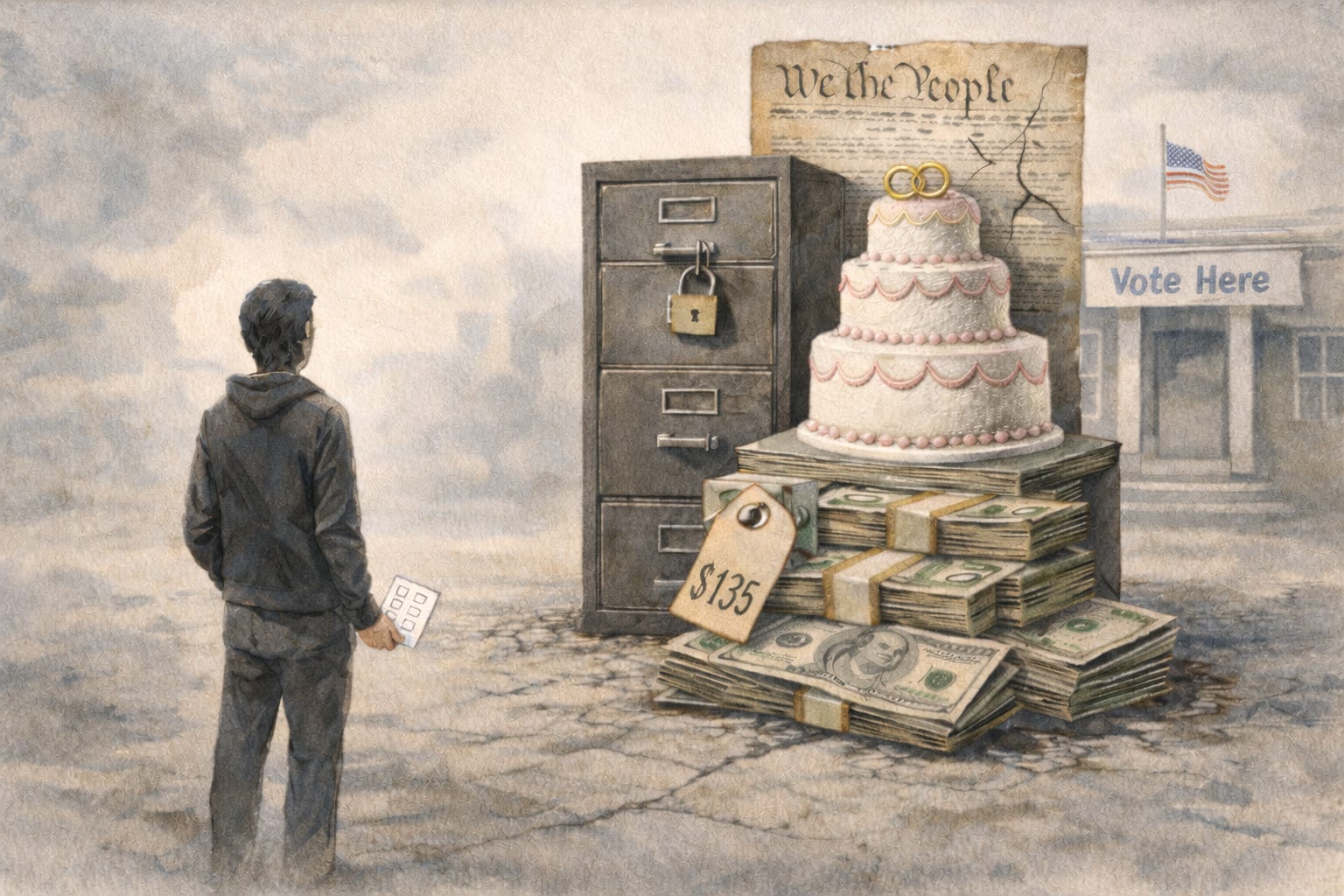
The 24th Amendment explicitly bans poll taxes, or a fee to vote. Courts have been inconsistent in their interpretation of how that applies to costs associated with obtaining identification, but the amendment's principle is clear. Voting cannot be conditioned on payment.
Beyond cost, there is another constitutional issue.
While Congress has authority over the time, place, and manner of federal elections, voter qualifications are reserved to the states. Article 1, Section 2 of the Constitution, the Seventeenth Amendment, and the Tenth Amendment all reinforce that balance.
The SAVE Act would face immediate constitutional challenges, with strong arguments that it exceeds federal authority by imposing voter qualification requirements rather than election procedures.
It is difficult to imagine this bill surviving judicial review.
What Voters Actually Want
Polls do show support for voter ID. They also show strong support for measures that make it easier for citizens to vote, not harder.
Americans consistently support:
Early voting
Universal access to mail-in voting
Automatic voter registration
Same-day registration
Making Election Day a national holiday
Restoring voting rights to felons who have completed their sentences
Those who tout the polling on voter ID as a reason for their suppressive legislation routinely ignore those other results, and often specifically undermine any efforts to enact them.
The Real Choice
Democracy is not about making voting harder for people you disagree with. It is about ensuring every citizen can participate equally. If election security is the goal, then voter protection must come first. Free IDs. Automatic registration. Transparent processes.
Restrictive voter ID and registration laws tip the scales by excluding voters instead of working to win them over.
Everyone deserves a voice and a vote.
https://www.ncsl.org/elections-and-campaigns/voter-id
https://www.brookings.edu/articles/how-widespread-is-election-fraud-in-the-united-states-not-very/
https://www.brennancenter.org/our-work/research-reports/debunking-voter-fraud-myth
