

No one in America is happy with the healthcare system. The problem we face is extreme disagreement over how to fix it.
There was widespread public support for extending healthcare subsidies, but the Republican Party opposed that approach, opting instead to reduce them, leading to millions losing their coverage. Even if they were extended, the subsidies are, at best, a much-needed band-aid until a better solution is implemented.
The Democratic Party previously pushed for universal healthcare, as the rest of the world uses, but while there is broad public support for universal healthcare, that support is split between those who believe it should be through private insurance and those who prefer it to be through the government. And overall, the Republican Party still opposes moving toward any universal healthcare system, creating a significant political hurdle.
Even talk of a public option for health insurance is mired in debate. We find ourselves in a sort of healthcare limbo where the problem worsens while no solutions are implemented.
But there is one affordable solution we could enact first to improve the situation.
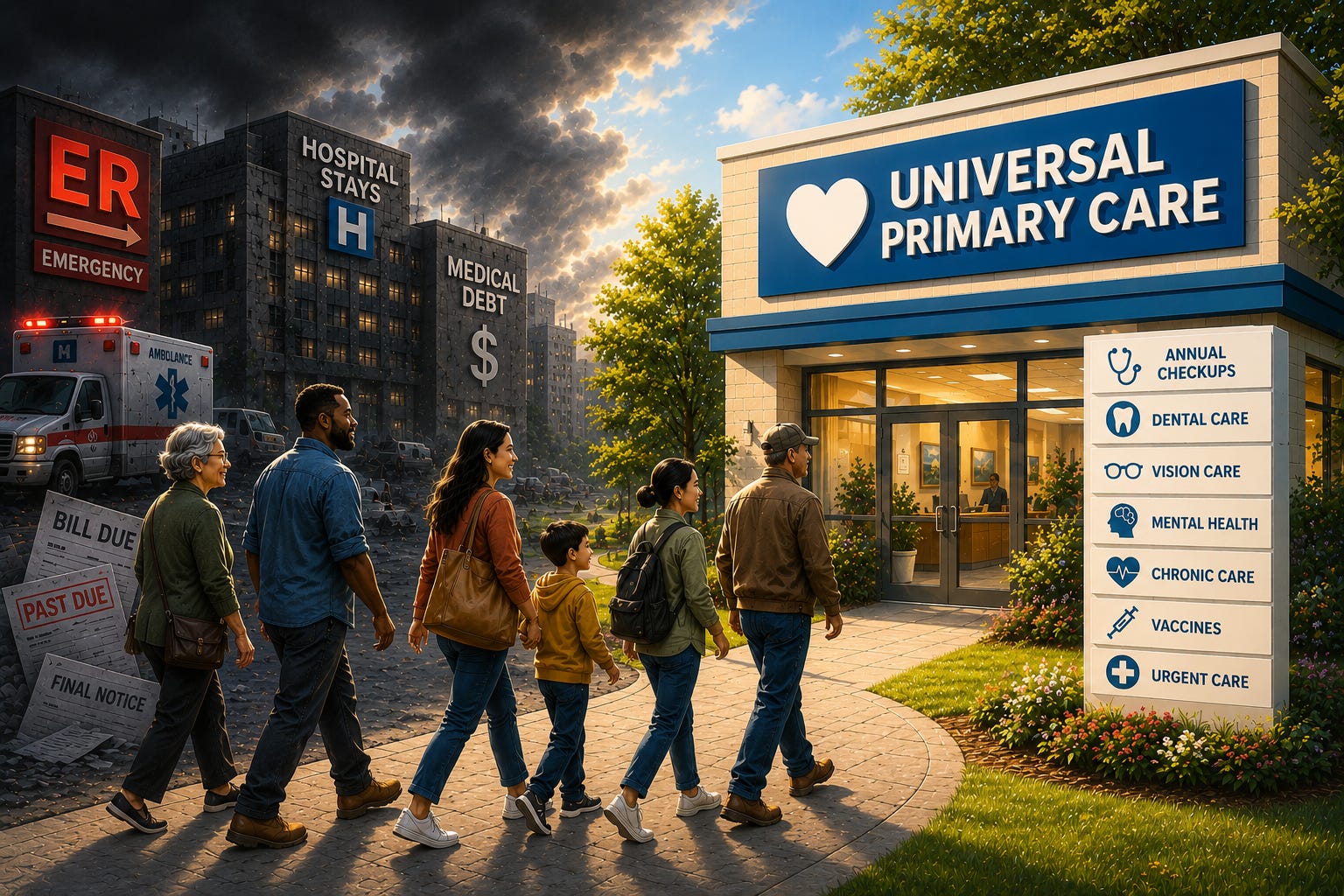
One of the most important and cost-saving forms of healthcare is preventative care. Discovering illnesses before they worsen makes them easier and less expensive to treat. It reduces hospitalizations and emergency room visits and results in fewer days of missed work. But while everyone can get treatment in an emergency room regardless of their insurance, not everyone has access to the most affordable and effective form of healthcare.
We can change that. We can provide universal, comprehensive primary care for all Americans for less than the requested increase to the military budget.
What is included in this comprehensive care?
Annual primary care visit
Preventive screenings
Vaccines
Chronic disease management visits
Follow-ups ordered by a primary care doctor
Post-hospital discharge follow-up
Mental health screening
Pediatric visits
Pregnancy-related primary care
Basic mental health integration
Medication management
Nutrition counseling
Basic urgent care for non-emergencies
Labs and routine diagnostics
Dental and vision checkups
A free pair of glasses once per year
Community health workers for high-risk patients
Dental and vision care are often treated as optional, but they are not optional if you are the person who cannot see well enough to work, drive, read, apply for jobs, or help your child with homework. They are not optional if an untreated dental problem becomes pain, infection, missed work, or an emergency room visit.
Chronic disease management means that an illness that could have ended your career becomes something that is fully manageable. A person who can get their blood pressure treated, diabetes managed, depression screened, or asthma controlled is more likely to keep working, keep earning, and keep supporting their family. Healthcare is not separate from the economy. Health is what allows people to participate in it.
This is real, extensive medical care that can transform lives.
The cost for this type of program would be under $300 billion per year. The choice is not whether we pay for care. We already pay. We pay when untreated diabetes becomes kidney failure. We pay when uncontrolled blood pressure leads to a stroke. We pay when a treatable infection becomes a hospitalization. We pay when someone misses work, loses income, loses insurance, and ends up in medical debt. Universal primary care means we pay earlier, when it’s cheaper, and before people’s lives fall apart.
In 2017, there were 3.5 million hospital stays that cost $34 billion, but were preventable with proper care. And that is an important part of this program: $200 billion in costs could be recouped through fewer emergency room visits, shorter hospital stays, reduced medical debt, and lower private insurance costs, because primary care would no longer be part of their services.
Compare this to the military budget that already costs $1 trillion each year, and the request is to raise it to $1.5 trillion next year. All other nations combined spend $1.9 trillion. That’s how close America is getting to outspending the rest of mankind on the ability to wage war. Why can we spend on waging unnecessary wars but not on keeping people healthy, active, and working?
We do not have to solve the entire healthcare system in one bill to make people’s lives dramatically better. We can start with the front door. Give every American access to a doctor, basic urgent care, dental checkups, eye exams, and glasses. Catch illness early. Keep people working. Keep families out of medical debt. Stop waiting until people are sick enough, desperate enough, or poor enough to qualify for help.
America already pays for untreated illness. Universal primary care lets us pay earlier, pay less, and save lives in the process.
We Must Fix America's Priorities

This is what the President of the United States said a few days ago: