

Immigrants in America are blamed for a lot of our problems. Crime. The national debt. A lack of jobs. Not only is this untrue, but America’s economy depends on immigrants, including undocumented ones.
Without them, the national debt would be past the breaking point, the population would be shrinking, and Social Security would have run out of money long ago.
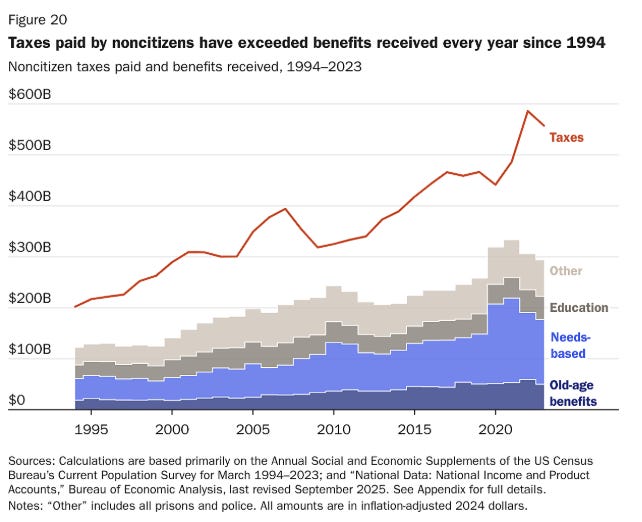
The Cato Institute is a Libertarian think tank that recently analyzed the economic impact of immigrants from 1994 through 2023. They found that immigrants paid more in taxes than they received in government benefits every single year.
This is true for both legal and undocumented immigrants and doesn’t account for indirect economic effects such as productivity growth, increased demand, and reductions in debt spending. Meaning that the full positive impact is much greater.
Immigrants are more likely to be working age and employed than native-born Americans. They fill critical worker shortages, increase tax revenue, and use fewer benefits, while the native born population is getting older and increasingly relying on those benefits.
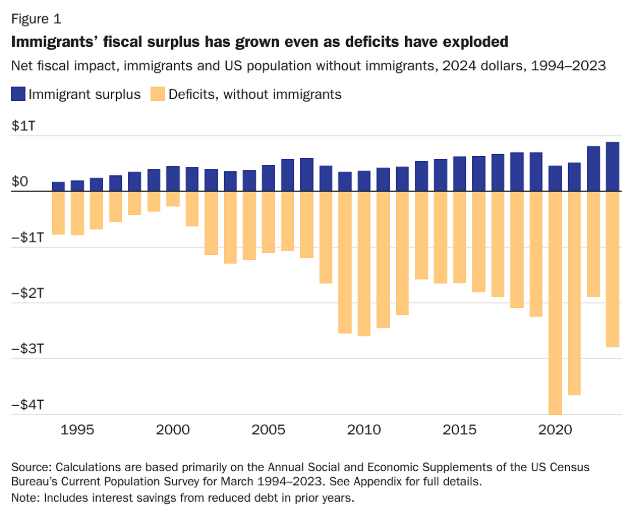
The math goes even further. Without immigrants, US debt-to-GDP would have already exceeded 200 percent, a threshold that makes paying even just the interest on that debt untenable, creating a crisis of rising interest rates, skyrocketing debt, and a weakening dollar that spirals out of control. Immigrants reduced deficits by one-third over the past 30 years.
Undocumented immigrants pay billions into Social Security despite being unable to claim those benefits. This has kept the system funded for citizens at a time when it is rapidly exhausting past surpluses. When those surpluses are used up, benefits will decrease significantly, something that would have happened years ago without these immigrants.
This is why mass deportation efforts don’t solve economic problems; they create them. We are spending hundreds of billions to decrease output, shrink the tax base, and reduce funds for important benefits like Social Security. Amid the scaled-up deportation efforts last year, native unemployment rates increased while labor participation rates decreased, and only 181,000 jobs were created over the year, compared to 2024, when over 100,000 jobs were created each month.
The focus of deportation efforts should be on dangerous criminals instead of farmhands, factory workers, and day laborers. Over 70% of people detained by ICE last year had no criminal convictions. The reason so few detainees have convictions is that undocumented immigrants commit crimes at less than half the rate of U.S.-born citizens. This was made clear when large numbers of migrants arrived between 2022 and 2024, and national crime rates continued to decline rapidly. Legal immigrants also commit crimes at lower rates than native-born Americans.
Immigrants are critical to our nation’s prosperity. America’s birth rate is far below the replacement rate. Without immigration, the population would have been shrinking since the 1970s. A shrinking population means there are fewer workers, fewer consumers, and a strain on federal programs. It would be devastating to the US economy, which relies on consumer spending for 70% of GDP, and on the constant influx of new workers to support those who have aged out of the workforce and onto Social Security and Medicare. Japan is already facing this problem, and sells more diapers for adults than for babies. That means fewer workers supporting more retirees, causing increased pressure on public services.
The United States is currently falling 1.1 million births short each year of what is needed to maintain its population. Legal immigration fills 800,000 of the gap annually. The rest is filled by undocumented immigrants. Even if birth rates increased tomorrow, it would take two decades before those children entered the workforce. America will rely on immigrants to stabilize our population for at least the next 20 years, likely much longer, and has been doing so for the past 50 years.
Those immigrants have a higher rate of creating small businesses, have a disproportionately high share of patents and startups, and fill over half of the jobs in key areas like agriculture, construction, manufacturing, textiles, elder care, and hospitality. They aren’t taking our jobs. They’re creating them and filling gaps that native born Americans are not.
None of this means America should have open borders, but we do need to fix our immigration system. A country that depends on immigrant labor while forcing millions to live and work without legal status has built a system that is both economically and morally unstable.
If we want strong economic growth, financial security, and greater prosperity, then our immigration system needs to match reality. Caps on legal immigration must be raised to reflect the country's needs. Work visas should be easier to obtain in industries facing shortages. There needs to be a pathway to citizenship for long-term, law-abiding, hard-working undocumented immigrants.
It’s easy to say that they shouldn’t have come here illegally, but the truth is America needed them to, and didn’t provide a legal pathway for them to come here “the right way.” Over half of the undocumented immigrants living in America have been here for over a decade, and both political parties have failed to address the issue. Crossing the border is a civil offense. Punishing someone for it 20 years later, when they’ve spurred on our economy, paid for our benefits, and made a life for themselves here, is a cop-out. The blame lies with politicians and broken policies, not immigrants.
America has always been a nation of immigrants. We can have strong borders, stringent but fair asylum rules, and still welcome immigrants who will make our nation greater while building a better life for themselves.
America fails without immigrants, so we must not fail them.
https://www.cato.org/white-paper/immigrants-recent-effects-government-budgets-1994-2023
