

America loves to call itself the land of the free. We talk endlessly about freedom of speech, freedom of the press, freedom of religion, the right to bear arms, and the right to a fair trial. But when the government builds systems that track where we go, who we talk to, what we believe, and what choices we make, too many people look away and do nothing to stop it.
America has become a surveillance state.
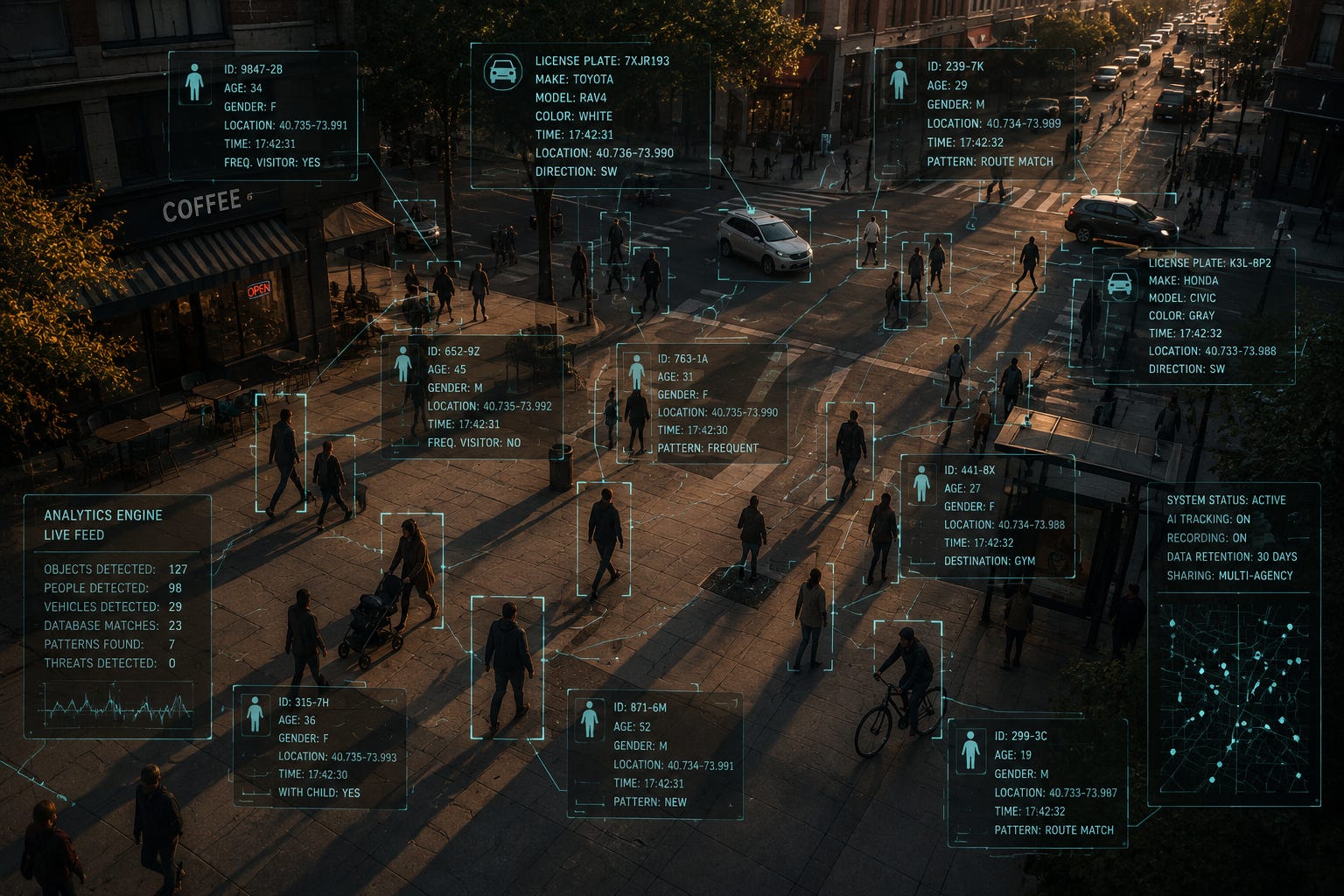
Our calls, texts, and emails can be swept into warrantless foreign-intelligence databases and searched later by U.S. agencies without the safeguards the Fourth Amendment requires. Our license plates are scanned and cataloged. The movements of our cars are turned into searchable histories. Cameras on roads, in parking lots, near stores, in neighborhoods, and throughout public spaces feed private databases that government agencies can search across state lines. AI is used to look through all of this data to find patterns in our lives. Patterns the government can use against us.
The right to privacy is failing.
The first major stage of this erosion of privacy came after September 11, 2001, when America was reeling from the most devastating terrorist attack to ever happen within its borders. Nearly 3,000 Americans had died, the mastermind was on the loose, and the government promised that new surveillance powers would protect the country from future attacks. The public accepted the bargain. Give up some privacy. Gain more safety.
The mastermind was killed. The wars launched after the attacks ended. But the surveillance continued.
Section 702 of the Foreign Intelligence Surveillance Act was sold as a tool for monitoring foreign threats overseas. But Americans’ communications were swept into the system and searched later without proper warrants. Congress repeatedly reauthorized and extended Section 702. Even after the authority finally expired in June, surveillance can continue under existing court certifications into 2027.
The government has used backdoor searches of this data for reasons unrelated to foreign intelligence or national security threats. Campaign donors and elected officials, including members of Congress, were spied on. Protesters and civil rights advocates were spied on. Batch speculative searches of tens of thousands of people happened without proper audits or legal requirements. NSA employees were even caught using surveillance tools to spy on spouses, former lovers, and romantic interests, an abuse known as LOVEINT, meaning “love intelligence.”
That is what happens when government power expands too far, and oversight is too narrow. The power never stays limited to the original promise. There is always some threat, some excuse, some new reason to extend the government’s reach into our lives.
The next stage was the government buying its way around privacy protections. Police generally need a warrant to get cell-site location records from phone companies. But instead of respecting that right, government agencies found another path.
Private companies collect the information, package it, and sell it. The government buys access to a map of people’s lives, bypassing constitutional protections. Companies such as Gravy Analytics and Venntel sold location data that tracked private citizens. Fog Data Science sold law enforcement access to location data collected from ordinary phone apps.
The new stage is mass surveillance on our streets, at businesses, and throughout public spaces. Flock cameras are being used across the country by government agencies and private institutions to build massive searchable databases on American citizens. These are often discussed as license plate readers, but they capture more than plates. Flock cameras can record vehicle make, model, color, and identifying details such as bumper stickers, dents, roof racks, and other visible characteristics. The system is building searchable profiles of vehicles and the people who use them.
This system is being abused.
One of the highest-profile cases was a woman in Texas who took abortion pills after being told her fetus was non-viable. Despite prosecutors telling police that this was not illegal under Texas’s abortion laws, they still ran an investigation into the woman. They accessed Flock’s database and searched data from more than 83,000 cameras in multiple states to track her.
When the search came to light, the sheriff claimed it was a welfare check because people were worried about her safety. But the incident report and affidavit showed the case was a “death investigation” of a “non-viable fetus.” The reason entered into the Flock database search was “had an abortion, search for female.”
That was not a missing-person search. It was not a welfare check. It was not a search for someone who had committed a crime. It was a hunt for a woman because law enforcement disagreed with her personal choices.
Even worse, a real crime had been committed, but it wasn’t the one police initially investigated. It was a crime against her. Less than an hour after her abortion, her partner choked her, put a gun to her head, and made her beg for her life. He was the one who told police about the abortion, which led to the multi-state search for her. He has been charged, and the case is ongoing.
A mass surveillance database was used to help an abuser find his victim. Intended or not, that is what happens when we don’t have a right to privacy.
Police in Wisconsin used Flock cameras to flag a vehicle for making regular trips across the border into Michigan, where marijuana is legal. Marijuana is illegal in Wisconsin. The car was tracked during one of those trips, and when it crossed back into Wisconsin, deputies pulled it over and searched it. Marijuana was found in the car, and the man was arrested.
The charging document stated, “Based on prior Flock hits, the vehicle travels to Michigan frequently, which is a known source State for Marijuana as it is legal there.” Deputies then made a coordinated effort to intercept the vehicle as it returned to Wisconsin.
The man also faced bail-jumping and domestic-abuse charges, but those were dismissed. The only crime he was convicted of was possession of marijuana. Police used a pattern of behavior monitored by Flock cameras as the reason to monitor, stop, search, and arrest him for a minor offense that would have been legal on the other side of the state line. Mass surveillance turned ordinary travel into probable cause.
Flock databases have also been used to monitor protesters, not because they were wanted for crimes, but to see whether crimes could be discovered to use against them. Police have used the database to stalk spouses, exes, love interests, and in-laws. Other reporting has shown police using Flock searches not merely to look for cars, but to search for people based on descriptions, clothing, body type, tattoos, and other identifying details.
This is what mass surveillance becomes when the rules are weak. It doesn’t stay limited to missing children, carjackings, or emergencies. It expands to attacks on reproductive rights, personal choices, and protesters. People who have access that is far too lenient and expansive in a sensitive system abuse it for personal issues.
Surveillance is a government power. Like every government power, it must be limited, justified, and watched. When privacy is protected, and when there are proper procedures requiring warrants based on suspected criminal behavior, surveillance can be a useful tool for finding violent criminals and stopping heinous crimes like human trafficking. But that is not the system being built.
The system being built stores vast amounts of data on ordinary people who are not suspected of any crime. It allows searches across jurisdictions. It allows government agencies to rely on private companies to gather information they could not easily collect themselves. It uses AI to sort through the data and identify patterns in our behavior, movement, relationships, routines, and personal choices.
That is not freedom.
When rights are violated, and we do not fight back, we lose them. We have to defend free speech even when we disagree with what is being said. We have to defend a free press even when newspapers investigate politicians we support. We have to defend free assembly even when protesters disrupt our lives. And we have to defend privacy even when people make choices we disagree with.
Because once the government builds the machinery to track everyone, it will not only be used against the people we fear. It will be used against whoever the people in power decide to target next.
The right to privacy is under attack. If we do not fight for it now, don’t be surprised when it disappears.
Abolish Ice. Restore Our Rights.

Another person was killed. Another tale was told by the Department of Homeland Security that painted the victim as the aggressor. And, as with case after case brought during this crackdown, the story began to fall apart as soon as the evidence was reviewed.